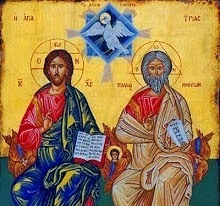
Genesis. We've foraged elsewhere for over two months, during the weeks of my sabbatical. Now, as we pick up the Scriptures together and turn back to the Bible's first book, we might have forgotten where we were. Let's remind ourselves of the gist of things so far. All things have their beginning in God – the God who is Trinity, who is Father and Son and Holy Spirit, the God who is Love. Because God is Love, he necessarily was fulfilled in his own life and goodness and being in eternity; and because God is Love, he freely created a world, not that he might seek fulfillment in it, but that it might enjoy fulfillment in him. All things surged into existence, made for God; but little sooner had we appeared than we derailed the purpose of the whole by surrendering to the voice of temptation and doubt and self-seeking. Grasping prematurely and presumptuously, we sinned against the beauty that was and could have been, and crafted instead the groaning life of woe, to spite Relentless Love.
In telling Israel and us of these things and what came after, the revealing God took the paler stories of the pagan cultures and transfigured them into something very different. In place of the pagan myths where the world was built on battle and bloodshed among the ancient gods, God turns it into a story where the one God peacefully constructs the world to be his holy temple, where all things reach their climax in the celebration of divine order. In place of the pagan myths where humans are clay and divine blood sculpted to toil in the gods' place as slave labor, God turns it into a story where, from dust and divine breath, humans are sculpted to be radiant images manifesting the one God's splendor. In place of the pagan myths where the building blocks of civilization came down as divine gifts on the wise and the weak, God turns it into a story where they're an afterthought tacked onto Cain's legacy of violence against Abel – and yet these inventions remain amenable to redemption. In place of the pagan myths of a heroic age where demigods gain legendary fame through mighty achievements and military prowess, God turns it into a story of nameless monster-men whose brutality but highlights the horrors of a world gone to hell. In place of pagan myths where the great flood told of divine peevishness, arbitrariness, and shortsightedness, God turns it into a story that bespeaks Divine Love's infinite determination to remake and renew the world from its worst – thus learned Noah. In place of pagan propaganda boasting of an empire's eternal glories and limitless potential, God turns it into a story casting lordly emperors as rebellious Nimrods, powerless in the long run of history. In place of Babylonian lore about their temple-speckled city's privileged place in the world as the gate of the gods where all goodness flows to, God turns it into a story of Babel's religious rejection, casting Babylon as a scene of scattering and divine abandonment. And yet, amidst it all, where pagan stories of humanity tended to be firmly fixed within their cultures, God offers in these old Hebrew Scriptures a picture of all nations as brothers and cousins, and the pagan peoples of the world as beloved prodigal sons whose greatest need across the earth is to rise and come home to the Father of All.
With these playfully redeemed stories in the background, God's revelation next applies a microscope to human history, bringing into view not a potent hero or a princely son or a primeval sage, but a seemingly cursed everyman chosen in his humble obscurity and invited on a mysterious and unthinkable adventure. Abram – later Abraham – is summoned to begin with a great renunciation of all that he was, in favor of a vision of what he could be made: a man whose name God, not himself, would magnify; a man whose life, when turned inside out, would be blessed and a blessing to the world. And with his intrepid yes began a saga now running longer in the book than the whole tale from the dawn of time to the first mention of his name. Over and over through his stumbling journey, he receives immense promises and covenants first by pure and simple faith, though by the day of fulfillment, his loving obedience has been woven in to make the gifts crowns. The promises include descendants for this childless man, land for this pilgrim far from home, a nation to proceed from this solitary nobody. And yet, through turns of international intrigue and domestic disharmony, Abraham is slowly forged into the father of faith, who begins – by faith, and by faith that works by love – to reap the gleaming firstfruits of his hope. His struggle climaxes with his last and greatest test. Where initially in faith he had to renounce his past, so lastly in faith would he have to renounce his future, returning it to the hands of the God who disguised his love. Trusting, reasoning, following, obeying, loving, worshipping, Abraham stepped forth to sacrifice the very heart of the promise; and, the demands of death being deferred, instead life and glory crowned his career and cemented his son Isaac as the man given supernaturally back to the world as if from the depths of the grave.
That done, “for all intents and purposes, [Abraham's] biography is complete.”1 All that remains is epilogue. In chapter 23, with legal negotiations ending with the entombment of the late Sarah to suffuse the soil, we saw this Abraham acting faithfully in the interest of the gift of the land. But that leaves the other branch of the promise yet unprotected: the pledge of seed to inherit. For whatever may hold for his other children, Abraham's heir apparent has become a man tested on the altar, but not yet on the marriage bed. Isaac is a bachelor. And before Abraham's days are done, it's his responsibility, before God and by his culture, to address that situation.
Before we even got down the mountain or knew of Sarah's demise, already we had foreshadowing of a solution. On the tails of heavenly heraldings of blessing for his future seed, Abraham hears – it isn't said from whom – the news of his long-lost brother Nahor, the one who caught up with their father Terah in the turf around Harran in northern Mesopotamia. Nahor, who'd married his niece Milcah, sister of Lot, had been blessed with eight kids by his niece-wife and four by his concubine Reumah – if you're counting, that adds up to twelve sons, the twelve tribes of Nahor (Genesis 22:20-24). Of those by the legitimate wife, the youngest was Bethuel, and we get a sneak preview of the fact that Bethuel has a daughter.2
As chapter 24 opens, we hear now: “Abraham was old, going on in days, and the LORD had blessed Abraham in everything” (Genesis 24:1) – a thing we wouldn't expect to hear about a widower, and yet human loss was no impediment to the riches of his faith.3 Old Abraham has a servant, whose name is left untold and who's shown as “the oldest of [Abraham's] household, who had charge of all he had” (Genesis 24:2). Effectively, this is his chief steward, his prime minister, “invested with considerable power and responsibility.”4 He's prudent, he's tested, and years of experience have taught him the answers to the question, “What would Abraham do?”5
It's because Abraham is so advanced in days that he urgently needs to finish this last responsibility and get the ball rolling toward grandchildren. And so to this chief steward he entrusts the vital mission: to arrange for the marriage of Isaac the heir – which may have been a delicate task to take up now, if, as some readers suspect, Isaac and Abraham have been a tad estranged since the knife came out on the mountain top.6 Abraham lays down just one guideline to follow: the wife cannot be “from the daughters of the Canaanites among whom I dwell” now, but the servant must go “to my kindred” to pick out Isaac's bride (Genesis 24:3-4). That means retracing Abraham's steps from chapter 12, five hundred miles or more. But we know that long-distance marriage arrangements weren't unheard of back then, among the elite; we have record of international royal marriages arranged through high-ranking court officials across similar distances.7
Before committing, the chief steward has a question. Suppose the woman he finds who meets the criteria isn't willing to take the trip? Should he come back and fetch Isaac to go meet her there (Genesis 24:5)? Absolutely not, says Abraham (Genesis 24:6). Abraham explains to his servant that “the LORD, the God of heaven,” is the one who originally took Abraham “from my father's house and from the land of my kindred,” and that same God “spoke to me and swore to me, saying, 'To your seed I will give this land'” (Genesis 24:6). Isaac, the seed, must never leave that land. As God swore on God to Abraham, so Abraham wants the servant to swear by “the LORD, God of heaven and God of earth,” to carry out this mission to fulfillment (Genesis 24:3). If the servant has concerns, Abraham has two words. First, a failsafe: if the chosen woman refuses to follow, then the servant is freed from his oath; he can't override her free will. Second, an assurance: the God who swore “will send his angel before you, and you shall take a wife for my son from there” (Genesis 24:7). “I have no doubt that the Lord will take care of you.”8 Abraham thus “entrusted [Isaac's] betrothal to divine providence.”9
And that's all the steward needed to hear. “The servant put his hand under the thigh of Abraham his master and swore to him about this thing” (Genesis 24:9). It's a custom that befuddles scholars, but St. Augustine called it “a great prophecy concerning Christ, because the Lord himself, the God of heaven and the Lord of earth, was to come in the flesh which was generated from that thigh.”10 And that's who this is ultimately about: Christ, who had been promised through the natural line of descent from Abraham through Isaac and his bride-to-be. This steward's mission is to arrange the match of the ancestors of the Savior of the world.
Abraham's directions are a tad vague, but the steward goes to Aram-naharaim, which is the (later Aramean) land of Naharima in the Great Bend of the Euphrates.11 The journey to get there would've taken about a month or so, at least.12 We'll later learn that the chief steward hasn't gone solo; he's got a staff of fellow-servants under his direction (Genesis 24:32, 54, 59). They make their trip on ten camels, and a camel in those days woulve' been basically “a Bronze Age luxury car,” the equivalent of a fleet of Ferraris pulling up in Aram-naharaim.13 Not only that, but the camels carry “many choice gifts,” the shiniest treasures from Abraham's vaults.14 No wonder the steward doesn't go alone; he's got an “armed escort” as sure as any armored truck.15 The month's journey being uneventful, we park the camels in the vicinity of the village spring outside either Harran or Nakhur, whichever is meant by “the city of Nahor,” somewhere Abraham's nephews might be (Genesis 24:10-11).16
So what does the steward do first, now that he's arrived? Simple: he prays. The man prays for the mission he's on. It's all the more remarkable because this prayer comes straight from the heart – there's no formality to it – and it's spoken by a nameless man.17 But he dares to pray to “the God of my master Abraham” (Genesis 24:12): the steward has a relationship with Abraham, who has a relationship with the LORD, and so by the transitive property, the steward can relate to God on that basis.18 The steward asks for two related things: for God to “show kindness to my master Abraham,” and for God to do so by “granting success before my face today,” success here and now where he can see it and know (Genesis 24:12).
Now the servant sets up, in his prayer, a test. Young women from the city are approaching to do their last chore, which is to haul water out of the well into jars and take it back home. The servant intends to approach them and ask for a drink from their jar, even though he's a stranger to whom they might feel no sense of obligation.19 The steward asks God to orchestrate it so that one will not just grant his request but go beyond it; and he asks God to “let her be the one whom you have appointed for your servant Isaac; by this I shall know that you have shown kindness to my master” (Genesis 24:13-14), if God should now “guarantee the coincidence.”20
Now, remember what Abraham's criterion for Isaac's wife was: she had to be from Abraham's kindred, which most people around here aren't. That's the only thing Abraham specified; he trusts his servant to take care of the rest. So the steward has now supplied his own criteria. The woman must be God's choice, and that must be obvious based on her lavish generosity to a stranger – the generosity Abraham himself would show, so that this union with Isaac would introduce “no difference of values” to the family.21 So here are three standards: Isaac's wife has got to have the right heritage, the right character, and divine appointment.
Before the steward even wraps up the last words of his prayer, a young woman catches his eye. He has no idea yet if she meets any of those three standards, but she's “very good to behold,” a village beauty queen (Genesis 24:15), and we're told she's a virgin, suggesting the virtue of chastity (Genesis 24:16). The steward also notices that, in a world where being sent to the well at dusk was a chance for village women to take time socializing and gossiping, this young woman stands out by being all business.22
As she starts to walk away with her full and heavy jar on her shoulder, the steward runs to intercept her, asking humbly for just a sip of water – a modest request (Genesis 24:17). She obliges, deftly swinging the jar down in her hands for him (Genesis 24:18). The servant drinks in suspense, and only when he's done does she make the offer he's been waiting for. She offers to give water to his camels – and not only as a token gesture for each, but to keep watering them “until they have finished drinking” (Genesis 24:19). She empties out the water she meant to bring back to her family into a trough, and then runs energetically back to the well to haul up more water. Now, for ten camels to have their thirst quenched would have taken more than 250 gallons of water, which meant maybe a hundred trips to the spring and back.23 Think about what that says of her – at the end of the day when she expected to get this last chore over with, she'll leap into action and invest an hour or two of extra labor just to make sure that even the animals are fully satisfied. That's “heroic strength and generosity.”24
Through all this, Abraham's chief steward “gazed at her in silence,” “studying the maiden's very words, her gaze, her walk, her appearance, everything about her,”25 “to know whether the LORD had prospered his way or not” (Genesis 24:21). He's stunned speechless, absolutely amazed, dizzied by the excess. He's convinced – but he's still cautious. He still doesn't know if she meets the requirement of being of Abraham's kindred.26 What he sees looks like a clear answer to prayer, but people in the ancient Middle East trying to get answers from the gods always double-checked even what seemed clear as day.27
So first he gives her “a recompense and reward for her courtesy,”28 which in retrospect is a downpayment on her bride-price, in the form of gold bracelets and a gold nose-ring. Then, with her attention secured, he asks two questions. First, what family are you from? That will clear everything up. And second, can we all stay in your father's house (Genesis 24:23)? Clever man that he is, by asking about her father's house, he's implicitly verifying she isn't already married.29 She answers both questions promptly and abundantly.30 Where he asked after her father's name, she gives him not only her father's name, Bethuel, but the names of her paternal grandparents, Nahor and Milcah (Genesis 24:24). Where he asked about room for the night, she not only offers it but specifies provisions for the camels (Genesis 24:25).
With answers that more than suffice, the steward is overcome by awe that, with little more than a general region to go on, he'd been led precisely to his master's nephew's home and to his daughter, the grandniece of Abraham – and what girl could fit any better what Abraham was asking for? There is no standard either Abraham or his steward came up with that she doesn't fit. She's a perfect match, 10 out of 10. She's a godsend; this is just so meant to be. So the servant bows down and names the LORD in this pagan place, uplifting the LORD's kindness and faithfulness to Abraham. He confesses that God “saw to the outcome of all these events.”31
As he praises, the young woman – Rebekah – learns three things she couldn't yet have known. First, this man with the luxury rides full of treasure isn't a great nobleman rich in his own right, but the servant of a man who's far greater still. Second, this greater master has a personal God whose name might be somewhat familiar to her, even though her own family has a tradition of moon worship. And third, this great master is a long-lost member of her own family's clan, matching the stories she's no doubt heard of her grandpa's stray brother. And so, with her characteristic verve, the young woman takes to running to her mom to share this news (Genesis 24:28). I wonder whether she ran with a full jar of water on her shoulder, or whether she left her jar behind in her haste.
Among those who catch word is her brother Laban, who – in what seems like Bethuel's absence or ailment – has a leading guardianship role over Rebekah. His attention is ensnared by her bling; so, with dollar signs in his eyes, he runs (which runs in the family, I guess) to find the steward and make good on the offer of hospitality Rebekah had already made (Genesis 24:29-31). Laban's perception of the steward as “blessed of the LORD” is no doubt based on the many treasures he has with him,32 but the steward zeroes in on the fact that Laban acknowledged the LORD – that, even out here in pagan country with the moon men, there's an openness there.33 The steward follows; he and his men unload the camels, wash their feet, come to the table. Ordinarily, it was impolite for a host to question a guest until after the guest had eaten; but the servant himself breaks the protocol by refusing to eat until he's shared what he's come to say – which is fine by Laban (Genesis 24:32-33).
The next stretch of verses (Genesis 24:34-48) sounds awfully repetitive, and it is, on purpose. The steward rehearses for the family everything we've just read since the chapter started. So we're meant to listen carefully for how he tailors it – the things he adds, subtracts, rewords, reorders. He leaves out Abraham's memory of being called away from his land and kindred, and the fact that Isaac is forbidden to ever go back there. Why? To avoid unnecessary offense. To that end, he also skips over the promises and covenants. What he does add is a description of how wealthy and powerful the LORD made Abraham, and a statement that Isaac is designated the sole and exclusive heir of all this – underscoring a trait that makes Isaac a most eligible bachelor. He adapts the vocabulary he uses, sticking in extra positive references to their family, and mentions the oath to find Isaac's wife only from them – all things that would flatter without seeming heavy-handed. And he reorganizes his story to erase any room for doubt that Rebekah is the one intended.34 In the end, the steward's discourse is a tale of “God's providence so manifestly in action” as to be beyond reasonable doubt.35
Finally, the steward wraps up his speech, which has highlighted the divine appointment of this whole situation, by coming to his goal: a marriage proposal to Rebekah on behalf of Abraham's son Isaac, Bethuel's cousin. And he presses the family to reach their decision as her legal guardians. He sets before them a choice. There's one path, which is “to show kindness and faithfulness to my master” Abraham by honoring his petition for a marriage match between Isaac and Rebekah. Then there's the other path, which is to refuse kindness, to refuse faithfulness, to spurn the proposal and thereby defy the manifest will of God. Either way, they're to answer now, so that, if need be, he “may turn to the right hand or the left” to continue his quest (Genesis 24:49).
As Rebekah's guardians, we hear from Laban and, for the first time, from homebound Bethuel. They may be in paganism's grip, but they know when a god's will is clear – and the LORD's is. Just as they know the steward isn't really free to turn to the right or the left, so they confess they can neither reject or initiate what God has already moved – “we cannot speak to you bad or good” (Genesis 24:50).36 So they announce their acceptance: “Behold, Rebekah is before you. Take her and go, and let her be the wife of your master's son – as the LORD has spoken!” (Genesis 24:51). That seems to settle it: they consent to the marriage, and do so in explicit submission to the word of God! No wonder the steward worships yet again. “In everything that happened, he gave thanks to the Lord of all..., who prepared everything in advance and, in response to the patriarch's prayer..., conducted the whole business for him.”37
From Abraham's treasures, he doles out to Rebekah her fuller dowry now in clothes and jewelry, and also pays the customary compensation to her family for the daughter whose labor will no longer be in their house – but he bucks custom by giving to the family last and the bride-to-be first.38 What comes next is the betrothal feast where representatives of both families eat and drink (Genesis 24:53-54). But then comes the next morning, where things hit a potential snag. The steward's goal is to get the bride back to her still-oblivious groom, and so far he's soft-peddled the imperative of him being bound to the promised land – so when he asks to be promptly dismissed, Laban and Mrs. Bethuel stall. It was customary for there to be extended farewell ceremonies, time to prepare a daughter materially and emotionally for her new life. What the steward asks is, yet again, a breach of protocol. The family insists on delaying departure for “days or ten” (Genesis 24:55). The steward balks, hinting that to tarry would be to kick against the goads of God (Genesis 24:56).
So Laban and Mrs. Bethuel suggest a way to resolve this impasse: they'll “call the young woman and inquire at her mouth,” asking her directly, “Will you go with this man?” (Genesis 24:57). It's an odd sequence, but it brings us back to the servant's original worry, which was that the young woman would refuse to follow him to the promised land (Genesis 24:5). He was never worried about her family's will; he was worried about hers, the only word that can dispel his oath. Everything hinges on what comes out of her mouth next, and now is where we as readers realize that nobody has actually asked Rebekah yet.39
What she says is as short and sweet as Hebrew can be: one word, two syllables: “I'll go” (Genesis 24:58). With that, she undoes the knot, releases the tension, endorses the message, enables the action. Think what this means for her. Rebekah, having grown from this pagan branch of the Terah family tree, is confronted by a call to give up everything familiar for a land she's never known, for a groom she's never seen, for a future she can't predict. But she'll take the offer on faith, she'll step out in hope. She'll surrender what she has, she'll say goodbye to the people and places she knows. Why? Because she's found herself swept up in the best-laid plans of a good God who, though maybe strange to her, has made his kindness and faithfulness known, and “she knew it was the will of the Lord that she go.”40 Does that remind you of anybody? It should! Rebekah, with her determination to go despite the implicit temptation of mother and brother to stay, “recapitulates the pattern of Abraham.”41 And she does so even though she's got no supernatural voices or visions spurring her on, not even an inner prompting in the depths of her heart, only an everyday trust that behind the scenes of natural means is the hand of the Holy.42
Once she's spoken, the matter is settled. Her family dismisses Abraham's steward and his fellow-servants, and not only Rebekah but her former wet-nurse Deborah, who would've helped raise Rebekah and will be ideal to stay on as her chaperone, plus several maidservants, Rebekah's closest gal pals since childhood – this was how a princess would be sent off, and so is she.43 There's only one last thing they have to say: “Our sister, may you become thousands of ten thousands, and may your seed possess the gate of his enemies!” (Genesis 24:60). If their parting blessing sounds at all familiar, again, it should! Before Abraham descended from Mount Moriah, the LORD swore to him to “surely multiply your seed as the stars of heaven and as the sand on the lip of the sea, and your seed shall possess the gate of his enemies” (Genesis 22:17). Without any way to know it, Laban and crew have applied to her the very words of God to Abraham and, through him, to Isaac. One early Christian remarked here that “the Lord of all arranges for the future to be foretold even by non-believers.”44 This is just one more way of confirming that this is a heaven-made match, that this is providence at work.
With that, the caravan leaves Aram-naharaim for south Canaan, over a month away. But we leapfrog that time and, with a change in scenery, find ourselves with Isaac living in the semi-desert Negev, coping with his grief for his late mother (Genesis 24:62). One day, as the sun is nearing the horizon, Isaac is in the field, and he's doing... something. There are bunches of ways to read this Hebrew word. Maybe he's walking around, maybe he's talking, maybe he's praying and meditating – when, just then, he “lifted up his eyes and saw, and behold, there were camels coming” (Genesis 24:63).
With a handy switch of perspective, now we're with Rebekah, and at the very moment Isaac lifts his eyes to the approaching camels, she on camel-back lifts her eyes and sees him, “and when she saw Isaac, she fell from the camel” (Genesis 24:64). Translators like to soften this for the sake of her dignity, but camels are tall, and there isn't a gentle way to get down while they're in motion. Rebekah's eagerness suggests that the vision of Isaac arrests her attention; it's like a scene out of a Hallmark Channel movie. As Isaac walks their way, she asks the steward, “Who is that man, walking in the field to meet us?” And now comes the simple, surprising answer. “The servant said, 'It is my master'” (Genesis 24:65). All through the chapter, this steward defined himself as “Abraham's servant” (Genesis 24:34), who swears to “Abraham his master” (Genesis 24:9), who prays to the “God of my master Abraham” (Genesis 24:12); Isaac, when mentioned, has been the steward's “master's son” (Genesis 24:51). But now, says the steward, “He is my master” (Genesis 24:65). The saga of Abraham has ended. The torch has passed from father to son.45 Isaac must become patriarch; will Rebekah be his matriarch?
Responding to the information, Rebekah “took her veil and covered herself” (Genesis 24:65). Unlike parts of the Middle East today, Hebrew women didn't veil themselves just to be in public; this is a cue from Rebekah that she's there for a wedding.46 And now “the servant told Isaac all the things he had done” (Genesis 24:66). The whole mission is laid bare; the results are placed at the new master's feet. The servant has done his part, he fulfilled his oath to the old master, he brought Rebekah on a long journey, but now what if Isaac says no? What if he doesn't like the looks of her? What if he feels pressured and offended? What if he turns her away? What if Isaac even reveals he married a Canaanite woman in the Negev while the steward was gone, and made all this effort pointless? What then?
But of course that doesn't happen. This was God's will. And Isaac, in freedom, accepts. “Isaac brought her into the tent of Sarah his mother,” vacated by Sarah's death three years earlier, “and he took Rebekah, and she became his wife, and he loved her; so Isaac was consoled after his mother” (Genesis 24:67). So ends the story. It's an arranged marriage, to be sure.47 Rebekah's had weeks on the road to pester the steward for Isaac intel, but Isaac hadn't so much as heard of Rebekah when he made his bed that morning. Yet each of them, in this night, gives the consent that ratifies a true marriage, and then they consummate it. Why? Not just because they trust their families and their wisdom, but because they trust that God is the author of the profound love they discover.
It's a sweet and beautiful story, with a fair number of things to teach us about marriage, this being the first time in the Bible the word 'love' is put in the context of a husband and wife. But there are three other key takeaways God intends for us here. First, take a good look at Rebekah. Early Christians, as they read the verses she came on stage, saw “a healthy and hospitable maiden, one whose demeanor would show her to be eager for love.”48 They took note of her “ineffable enthusiasm..., her modesty, her surpassing humility, and the extremity of her hospitality.”49 They took Rebekah as a model of a virtuous woman, and so should we. She's modest and humble, she's chaste and conscientious, she's generous and strong, caring and daring. She's an example, not just for women, but for all of us. Even without the benefits of the truth she'll come to know, even without special revelations, she's a junior Abraham in the midst of the natural world of secondary cause-and-effect.
Speaking of that world, this chapter is a celebrated case study in divine providence. There are no miracles here – no laws of biology transcended, no heavenly apparitions, no shouts through the clouds; water stays water, not wine. And even so, the LORD is speaking. God has all these things in his hand, moving them toward his ends without ever running roughshod over the freedom we – Abraham and steward, Isaac and Rebekah, Laban and you and me – enjoy on our lower level of causality. God, operating at a higher level as first cause, is sovereign and guiding events, ordering all things sweetly. The eyes of the characters on the page, the eyes of the people in history, are opened, two by two, to how “the guiding hand of Providence is present from first to last” in what might otherwise be dismissed as “the commonplace and the natural.”50 God's angel goes before the prudent and pious steward, just as God's ministering angels go before each human born into this life. The God of heaven, the God of earth, wants to providentially guide your life to lead you to the prospect of glory; attend patiently.
But for the last lesson, we have to climb from the letter to the spirit, and realize what this chapter signifies. In a nutshell, what's going on here? A father is taking action to secure for his son and heir a qualified bride, and doing so through the mission of his servant, who will bring the bride to her groom so that life may go on. And what's the story of the world? The Father taking action to secure for his Son a qualified Bride through the mission of his servants. In the pages of Genesis 24, Christ is “signified by Isaac.”51 For just as Isaac was the sole heir of Abraham, so Christ is God's only-begotten “Son whom he appointed heir of all things” (Hebrews 1:2). Who, then, does Rebekah point to? In her, the great teachers of faith saw, “there is clearly revealed the beauty of the Church.”52 The Church is “the Bride, the wife of the Lamb,” the True Rebekah for the True Isaac (Revelation 21:9), the Christ who is “the Holy Church's Bridegroom.”53
So who is the steward who goes forth? Some said the prophetic words of the Old Testament, for “the Church followed the prophetic word, to be sure,”54 so that “just as through Abraham's servant a bride is brought for blessed Isaac, so by his prophetic word the Church... is invited to Christ the True Bridegroom.”55 Others have suggested Christ himself in his dual role, or even the Holy Spirit venturing into the world at Pentecost.56 But the Spirit filled first and foremost Jesus' apostles, “who became keepers and stewards of the mysteries, having in their hands, so to speak, everything in their master's house.”57 No wonder St. Paul told the Church how he felt “a divine jealousy for you, since I betrothed you to one husband, to present you as a pure virgin to Christ” (2 Corinthians 11:2). The apostles “became, as it were, those... who lead forth the Bride” to her Bridegroom,58 meeting the Bride at the well of baptism, adorning her with the golden treasures of the grace of God, and discipling her for the journey. “Rebecca would not be led to Isaac if she did not say, 'I am going,'” one old saint pointed out, and “neither would the Church be joined to Christ if she did not say, 'I believe!'”59
But if Rebekah stands allegorically for the Church, she stands tropologically for the human soul – because each and every soul is individually sought for a relationship with Jesus Christ.60 “All these things which are written are mysteries. Christ wishes to espouse you also to himself.”61 On this level of meaning, Rebekah stands for “the soul thirsting for God,” for “no sweeter names can be found to embody that sweet interflow of affections between [Christ] and the soul than 'bridegroom' and 'bride,'” as St. Bernard put it.62 Each soul who says the yes of faith, the 'I'll go' of faith, is “receiving at present the blood of her Spouse as a precious dowry,” and will “later receive the dowry of his kingdom.”63 Your soul has been sought. Your soul has been favored, adorned with the gold of the Spirit. Your soul is being led, carried away, to the joy that's set in store.
But that's not the only role for us to play. For with the Holy Spirit going before us, we are servants and camels on a journey to find our Isaac's bride in the next soul, and in the next, and in the next. We don't have to be the chief steward, but we're bound to go with that grace, to make the journey, to seek out those prepared for their espousal, to diplomatically win them for the promised land. Because God is Love. He has been since before the first dawn. He made this world because he is Love. He made you because he is Love, and he made that prodigal-son soul out there because he is Love. We are sent to secure the Son his bride, to lead that soul to Jesus. That's our task, as fellow-servants participating in the apostolic mission: to “summon to the wedding banquet..., bringing near those yet far off and joining them to Christ, binding them together in the unity of the Spirit.”64 As we marvel at the sovereign providence of God, as we imitate the virtues we've read, as we recognize in Isaac and Rebekah the mystery of Christ and his Church, may we both marry our souls to Christ and win others to his love. Amen.
1 Nahum M. Sarna, Genesis (Jewish Publication Society, 1989), 156.
2 Bruce K. Waltke, Genesis: A Commentary (Zondervan Academic, 2001), 315.
3 R. R. Reno, Genesis (Brazos Press, 2010), 211.
4 Nahum M. Sarna, Genesis (Jewish Publication Society, 1989), 162.
5 Jack M. Sasson, “The Servant's Tale: How Rebekah Found a Spouse,” Journal of Near Eastern Studies 65/4 (October 2006): 249.
6 Leon R. Kass, The Beginning of Wisdom: Reading Genesis (Free Press, 2003), 367.
7 Kenneth A. Kitchen, On the Reliability of the Old Testament (Eerdmans, 2003), 318; Jack M. Sasson, “The Servant's Tale,” Journal of Near Eastern Studies 65/4 (October 2006): 243.
8 John Chrysostom, Homilies on Genesis 48.12, in Fathers of the Church: A New Translation 87:31.
9 Theodoret of Cyrus, Questions on Genesis 75.1, in Library of Early Christianity 1:153.
10 Augustine of Hippo, Questions on the Heptateuch 1.62, in The Works of Saint Augustine: A Translation for the 21st Century I/14:38.
11 Nahum M. Sarna, Genesis (Jewish Publication Society, 1989), 163-164.
12 David W. Cotter, Genesis (Liturgical Press, 2003), 165.
13 David W. Cotter, Genesis (Liturgical Press, 2003), 166.
14 Ephrem the Syrian, Commentary on Genesis 21.3, in Fathers of the Church: A New Translation 91:170.
15 James McKeown, Genesis (Eerdmans, 2008), 122.
16 Bill T. Arnold, Genesis (Cambridge University Press, 2009), 221.
17 Nahum M. Sarna, Genesis (Jewish Publication Society, 1989), 164.
18 James McKeown, Genesis (Eerdmans, 2008), 123.
19 John Chrysostom, Homilies on Genesis 48.15, in Fathers of the Church: A New Translation 87:33.
20 Leon R. Kass, The Beginning of Wisdom: Reading Genesis (Free Press, 2003), 370.
21 Theodoret of Cyrus, Questions on Genesis 75.2, in Library of Early Christianity 1:155.
22 Nahum M. Sarna, Genesis (Jewish Publication Society, 1989), 164.
23 Leon R. Kass, The Beginning of Wisdom: Reading Genesis (Free Press, 2003), 371; Jack M. Sasson, “The Servant's Tale: How Rebekah Found a Spouse,” Journal of Near Eastern Studies 65/4 (October 2006): 251; Brian Neil Peterson, Genesis: A Pentecostal Commentary (Brill, 2011), 211; Stephen K. Ray, Genesis: A Bible Study Guide and Commentary (Ignatius Press, 2023), 233.
24 David W. Cotter, Genesis (Liturgical Press, 2003), 166.
25 John Chrysostom, Homilies on Genesis 48.17, in Fathers of the Church: A New Translation 87:34.
26 Tremper Longman III, Genesis (Zondervan Academic, 2016), 316.
27 Jack M. Sasson, “The Servant's Tale: How Rebekah Found a Spouse,” Journal of Near Eastern Studies 65/4 (October 2006): 255.
28 Josephus, Antiquities of the Jews 1.249, in Loeb Classical Library 242:123.
29 Jack M. Sasson, “The Servant's Tale: How Rebekah Found a Spouse,” Journal of Near Eastern Studies 65/4 (October 2006): 255-256.
30 John Chrysostom, Homilies on Genesis 48.18, in Fathers of the Church: A New Translation 87:34; Leon R. Kass, The Beginning of Wisdom: Reading Genesis (Free Press, 2003), 371.
31 John Chrysostom, Homilies on Genesis 48.16, in Fathers of the Church: A New Translation 87:33.
32 Alex Varughese and Christina Bohn, Genesis 12-50: A Commentary in the Wesleyan Tradition (Beacon Hill Press, 2019), 174.
33 Jack M. Sasson, “The Servant's Tale: How Rebekah Found a Spouse,” Journal of Near Eastern Studies 65/4 (October 2006): 256-257.
34 Nahum M. Sarna, Genesis (Jewish Publication Society, 1989), 167; Leon R. Kass, The Beginning of Wisdom: Reading Genesis (Free Press, 2003), 372; Jack M. Sasson, “The Servant's Tale: How Rebekah Found a Spouse,” Journal of Near Eastern Studies 65/4 (October 2006): 259-261.
35 John Chrysostom, Homilies on Genesis 48.24, in Fathers of the Church: A New Translation 87:38.
36 Jack M. Sasson, “The Servant's Tale: How Rebekah Found a Spouse,” Journal of Near Eastern Studies 65/4 (October 2006): 261.
37 John Chrysostom, Homilies on Genesis 48.26, in Fathers of the Church: A New Translation 87:39.
38 Shaul Bar, Daily Life of the Patriarchs: The Way It Was (Peter Lang, 2015), 38; Jack M. Sasson, “The Servant's Tale,” Journal of Near Eastern Studies 65/4 (October 2006): 261-262.
39 Leon R. Kass, The Beginning of Wisdom: Reading Genesis (Free Press, 2003), 372.
40 Ephrem the Syrian, Commentary on Genesis 21.4.2, in Fathers of the Church: A New Translation 91:170.
41 R. R. Reno, Genesis (Brazos Press, 2010), 215; cf. Alex Varughese and Christina Bohn, Genesis 12-50: A Commentary in the Wesleyan Tradition (Beacon Hill Press, 2019), 167.
42 Bruce K. Waltke, Genesis: A Commentary (Zondervan Academic, 2001), 326; R. R. Reno, Genesis (Brazos Press, 2010), 215.
43 Nahum M. Sarna, Genesis (Jewish Publication Society, 1989), 169; Jack M. Sasson, “The Servant's Tale,” Journal of Near Eastern Studies 65/4 (October 2006): 247.
44 John Chrysostom, Homilies on Genesis 48.28, in Fathers of the Church: A New Translation 87:40.
45 Terence E. Fretheim, Abraham: Trials of Family and Faith (University of South Carolina Press, 2007), 140.
46 Nahum M. Sarna, Genesis (Jewish Publication Society, 1989), 170.
47 O. Palmer Robertson, The Genesis of Sex: Sexual Relationships in the First Book of the Bible (Presbyterian & Reformed Publishing Company, 2002), 12.
48 Cyril of Alexandria, Glaphyra on the Pentateuch 3.3.1, in Fathers of the Church: A New Translation 137:161.
49 John Chrysostom, Homilies on Genesis 48.16, in Fathers of the Church: A New Translation 87:34.
50 Nahum M. Sarna, Genesis (Jewish Publication Society, 1989), 161.
51 Cyril of Alexandria, Glaphyra on the Pentateuch 3.3.2, in Fathers of the Church: A New Translation 137:162.
52 Ambrose of Milan, Isaac, or the Soul 3 §7, in Fathers of the Church: A New Translation 65:15.
53 Bede, On Tobias 8:11, in Translated Texts for Historians 28:70.
54 Origen of Alexandria, Homilies on Genesis 10.5, in Fathers of the Church: A New Translation 71:165.
55 Caesarius of Arles, Sermon 85.3, in Fathers of the Church: A New Translation 47:22.
56 Stephen K. Ray, Genesis: A Bible Study Guide and Commentary (Ignatius Press, 2023), 237.
57 Cyril of Alexandria, Glaphyra on the Pentateuch 3.3.2, in Fathers of the Church: A New Translation 137:163.
58 Cyril of Alexandria, Glaphyra on the Pentateuch 3.3.1, in Fathers of the Church: A New Translation 137:160.
59 Caesarius of Arles, Sermon 85.3, in Fathers of the Church: A New Translation 47:22.
60 Ambrose of Milan, Isaac, or the Soul 1 §2, in Fathers of the Church: A New Translation 65:11.
61 Origen of Alexandria, Homilies on Genesis 10.2, in Fathers of the Church: A New Translation 71:160.
62 Bernard of Clairvaux, On the Song of Songs 7.2, in Killian Walsh, tr., Song of Songs I (Gorgias Press, 2010), 38-39.
63 Caesarius of Arles, Sermon 85.4, in Fathers of the Church: A New Translation 47:23.
64 Cyril of Alexandria, Glaphyra on the Pentateuch 3.3.1, in Fathers of the Church: A New Translation 137:160.

No comments:
Post a Comment