Sunday, June 6, 2021

The Liberty of Rest

Had I a time machine, I might take us this morning to the foot of Mount Sinai. Not to witness the fire and hear the thunder – no, I don't know if we could bear it. But I would love to interview an Israelite in the camp – just anyone. Think of the story you might hear. Things had been fine, when their ancestors first came to Egypt, for Joseph was their protector. In those days, Egypt was ruled of men not of its soil, men who looked not so unlike the Hebrews. But then the Egyptians rose up and cast out their foreign rulers. The new dynasty, coming from far up the Nile, knew nothing of Joseph and his service. In their foreign wars, they took many prisoners from Canaan and the lands of Asia, and soon they could tell no difference between the sons of Israel and the prisoners of war. They treated them alike, enslaving them to the state to work on state projects. Some were sent to toil in the fields. Others made and carried bricks. As the latest pharaohs turned their focus to the northeast Nile Delta, many of the sons of Israel had been tasked there, making bricks and building storage facilities for a massive capital city bigger than Babylon. The quotas were set too high, and ever higher as Pharaoh's ambitions grew. It was exhausting and unrelenting, eight or more days a week. Workers in other camps appealed for religious holidays here and there, time off to offer to their gods. But the Pharaoh would hear nothing of the sort from his Hebrew slaves, lest his ambitions grind to a halt. So the sons of Israel slaved away. But then came the night of deliverance; the rush, the chase, the march to the sea; the fear, the awe, the passage on dry land; the dancing, the walking, the storm on the mountain; and then the word of the LORD who'd turned the gods of Egypt to mush.

When he speaks, God absolutely grants where they've been, he acknowledges their painful and strenuous past: “You were a slave in the land of Egypt.” But, God says, those days are over now, because he has become their Great Emancipator: “The LORD your God brought you out from there with a mighty hand and an outstretched arm.” And that change in status, from slave society to the light of liberty, is going to have some consequences on how they must live: “The LORD your God commanded you to keep the Sabbath day” (Deuteronomy 5:15). What God is saying here, in laying down this commandment, is: “You were treated as slaves, but that's not who you are! You were never made for slavery, never meant for slavery. So slave no longer! Live free!”

God forbids them, here, from working in their new society in the same tired way they used to in the old society. To be sure, for up to six days in a row, they can work as hard as they need to in order to get their tasks done: “Six days you shall labor and do all your work” (Deuteronomy 5:13), so long as they pray and rehearse the LORD's testimonies in the morning and at night (Deuteronomy 6:7). Between those prayers, for six days they can achieve all their achievements, accomplish all their accomplishments. But then comes that seventh day. Now, in slavery in Egypt, they would have always had to work seven days in a row. But not any more. On the seventh day, their economy grinds to a halt, their production reaches a standstill, their creativity pauses, the endeavors of earth fall silent: “The seventh day is a Sabbath to the LORD your God” (Deuteronomy 5:14). And that word 'Sabbath' is like a stop sign. When they see it, they aren't to build, they aren't to farm (Exodus 34:21), they aren't to create (Exodus 16:23; 35:3), they aren't to collect (Numbers 15:32-36), they aren't to carry things from here to there (Jeremiah 17:21-27), they aren't to buy or sell (Nehemiah 10:31; Amos 8:5), they aren't to pursue personal projects or mere pleasure or pointless conversation (Isaiah 58:13), they aren't even to wander too far from place to place (Exodus 16:29). There are six days for those. Sabbath stands apart from them.

Now, down through the ages, outsiders have thought this was weird. Plenty of Gentiles thought that this was a bad way to live. We know Romans in particular scorned the Sabbath and mocked the Jews as lazy cowards for living like this. They scorned the Sabbath as “an excuse for laziness,”1 saying the Jews were “led by the charms of indolence” into “inactivity,”2 so that they “gave up every seventh day to idleness.”3 But that's not what it's all about. This commandment contains a striking wisdom: If we don't stop, then our work will burn us up; but in one way or another, we won't stop until we're forced to stop. If an Israelite keeps working himself the way he worked in Egypt, then it's like he never left: he's enslaved himself. And if an Israelite works his brother to that same breaking point, then he looms over him like Pharaoh's very phantom. So God speaks.

As former slaves, Israel has exactly the background needed to really appreciate the magnitude of this gift. Each time Sabbath comes, they're reminded to celebrate that their slave life is over. They think back to the exodus, to God's daring rescue through the waters. They get a whole day to just bask in the reality of their accomplished emancipation. And this regular day of luxuriating in their liberty is a mechanism for interrupting daily drudgery with divinity on a predictable and regular basis. It's a day of healing. It's a day of reconnecting. It's a day made for regaining a healthy distance from the world's cares. For we have it on good authority that “the Sabbath was made for man” (Mark 2:27). That is, the Sabbath is engineered for the interests of human welfare. It's given us for our health. Sabbath is the satisfied silence that cuts off the drumbeats of slavery.

From that slavery, Israel has been set free; and not just set free, but set free into the life of God. For in keeping the Sabbath, Israel is being invited to imitate him. Sabbath is rooted in the rhythm of creation, the first bloom of the universe. God labored, syllable after syllable, for six days. But then he stopped. He wasn't tired, wasn't bored, wasn't weary: God is inexhaustible. No, he stopped and enthroned himself over his creation and basked in the accomplishment of his rule. And so he “rested on the seventh day” (Exodus 20:11). Now, Israel could have taken this as their cue to slave away, to ensure that God has the leisure to rest. The Babylonian creation story imagines one god declaring his idea to create humanity “on whom the toil of the gods will be laid, that they may rest,” so they made humanity “on whom he imposed the service of the gods, and set the gods free.”4 But Israel's story reasons the exact opposite way. God didn't create us to offload his responsibilities so he could live leisure. He created humans, he rested, and he now invites us to rest with and in him!

And so keeping sabbath was a gift – a gift meant to train Israel in the art of faith. For six days at a time, through the busiest harvests and most tumultuous storms, with demand after demand coming to their attention, a family in Israel would have to juggle their tasks like so many pins in the air. But every seventh day, no matter how many pins were in the air, each house would abruptly, in unison, drop their hands to their sides. They would not juggle. They would simply have to trust God to catch the pins and throw them back when the day was done. To live like this, stopping the juggling once every seven days, was a living declaration of their conviction that God is still enthroned in heaven, and from his sovereign throne, he'll watch over all the works of our hands while we simply bask in his goodness and his love. And so this special day was a chance to thrust away from us all our striving, and instead to lay claim to refreshment we haven't earned – just resting in God's own freedom.

Keeping sabbath was Israel's declaration of faith, a tutelage in the imitation of God. But it didn't just mean his pattern of work and rest. It also meant imitating his justice and his mercy. It isn't just the powerful householder who gets to enjoy sabbath. No work from “you or your son or your daughter or your male servant or your female servant or your ox or your donkey or any of your livestock or the sojourner who is within your gates, so that your male servant and your female servant may rest as well as you” (Deuteronomy 5:14). The poorest pauper gets the same sabbath guarantees as the prince or prophet. A daughter stands in the same freedom as a son, a servant the same as the master. A friendless immigrant, vulnerable to abuse, has all the same protections as the most Israelite of Israelites. No one would harass them, tell them to work more to prove themselves. They rested. Even animals received their rest! All the other days, they were employed for tasks around the farm. But come Sabbath, no humans made any demand on them. No horses would be pulling buggies that day. No ox would be yoked to the plow. Reflecting on the gift of Sabbath, one modern Jewish writer says it like this:

He who wants to enter the holiness of the day must first lay down the profanity of clattering commerce, of being yoked to toil. He must go away from the screech of dissonant days, from the nervousness and fury of acquisitiveness and the betrayal in embezzling his own life. He must say farewell to manual work and learn to understand that the world has already been created and will survive without the help of man. … Labor is the means toward an end, and the Sabbath as a day of rest, as a day of abstaining from toil, is not for the purpose of recovering one's lost strength and becoming fit for the forthcoming labor. The Sabbath is a day for the sake of life. Man is not a beast of burden, and the Sabbath is not for the purpose of enhancing the efficiency of his work. … The Sabbath is not for the sake of weekdays; the weekdays are for the sake of Sabbath. It is not an interlude but the climax of living.5

In fact, so beautiful was the sabbath to Israel that they projected it, like a signal in the clouds, until from this one bulb it dwarfed the year. And so we read that, just as each seventh day was a day of rest for man and beast, so each seventh year was its own kind of sabbath. But it was a sabbath for the land beneath their feet – for the soil itself. “For six years you shall sow your field, and for six years you shall prune your vineyard and gather in its fruits, but in the seventh year there shall be a Sabbath of solemn rest for the land, a Sabbath to the LORD” (Leviticus 23:3-4). To do that takes the same sabbath faith. If, week in and week out, they can learn to trust God to catch all their pins for twenty-four hours, then on the seventh year, they can be ready to trust God to feed them with the overflow of his blessing, even when the land doesn't work for it: “The Sabbath of the land shall provide food for you” (Leviticus 23:6). Now, sadly, in practice, Israel didn't live up to that call of faith. Down through their settled history, they almost never gave the land its sabbath rest. And in fact, that was one of God's motivations in exiling them later on: “The land shall enjoy its Sabbaths as long as it lies desolate..., the rest that it didn't have on your Sabbaths when you were dwelling in it” (Leviticus 26:34-35; cf. 2 Chronicles 36:21). They cheated the land so long that God stepped in and gave the land space for sabbath.

But not only was the seventh year a sabbath for the land. After each sabbatical year, all the debts between the people of Israel were cancelled out. “At the end of every seven years, you shall grant a release, and this is the manner of the release: every creditor shall release what he has lent to his neighbor. He shall not exact it of his neighbor, his brother, because the LORD's release has been proclaimed” (Deuteronomy 15:1-2). Just think of that: every seven years, all debt was predictably wiped away as a clean slate! And the purpose of legislating the cancellation of debts was so that “there will be no poor among you,” Moses says (Deuteronomy 15:4). That too was the goal of sabbath: they just had to write sabbath over years in order to hear it. Training in greater mercy.

But that's not all. Every seven clusters of seven years, after the debt release at the end of the seventh seventh, would give way to a special year. Each sabbath cycle of seven sabbath-year cycles would give birth to a year of special liberty, called a 'jubilee' (after the yobel, the kind of ram's horn blown to announce it). And on the Day of Atonement, that year would be a proclamation of “liberty throughout the land to all its inhabitants. It shall be a jubilee for you, when each of you shall return to his property and each of you shall return to his clan” (Leviticus 25:10). It meant a greater celebration of their freedom from slavery. It was like a massive reset button on Israel's society. Real estate went back to its rightful family: the old homestead came home. Families torn asunder were reunited. An Israelite, living a full life, could be guaranteed to see at least one jubilee in his or her lifetime. And that's what capped off the beauty of Israel's sabbath life. It said: “Let freedom ring!”

America, like Israel, has given at least lip service to all these ideas. You might recognize those words of jubilee as the inscription on the Liberty Bell in Philadelphia. It took a long time to appreciate that liberty and sabbath were for all the inhabitants of the land. In the 1800s, we have record of one woman who whipped and tortured her slaves before church, and when questioned by her pastor, she said, “If I were to whip them on any other day, I should lose a day's work; but by whipping them on Sunday, their backs get well enough by Monday morning.”6 That is no sabbath. That is no liberty. And even now, like the pagans of old, we've developed a culture where we tend to judge restfulness as if it were laziness. We too easily mock debt relief as a hand-out. We boast that we're the people of liberty, but we don't want the liberty of rest. We enslave others and ourselves. We pride ourselves about how busy we can be. In 1930, a leading economist predicted that, by the time we're now living in, Americans would have just a 15-hour workweek.7 That has not happened. Not even close. The average full-time American paid laborer works at their job for almost 1,800 hours each year.8 That's not as bad as it was in the thick of the Industrial Revolution, when the average exceeded 3,000 hours each year.9 But it's serious, especially when you consider that back then, about half the population wasn't doing paid labor. We work more hours than the British, the French, the Germans, even the Japanese. When we do work, we're more productive than ever, but a lot of that is driven by the rising workaholic class and our increasing demand that a job be not just a career but a calling, a fountain of meaning. And so, in practice, we often reduce ourselves to Mammon's handpuppets, to tools of industry, slaves even of our own goals and purposes.

To make matters still worse, a substantial number of American paid laborers – whether part-time workers doing shifts on scattered schedules they learn just days in advance, or people trying to get by in the gig economy – have no way to reliably predict when they'll be working, which means they can't know when they're secure to rest. And we can't forget that paid labor is just one of the many forms of work in our lives. There's housework. There's commerce. There are chores. There are all kinds of personal projects we set ourselves to, in what we claim is our 'down time.' Demands press on us from all sides. The taskmaster, whether outside of us or in our own minds, rules the roost. Every moment of our lives becomes economized. Everything is open for toil or exchange. Time is remarkably transubstantiated into money. And so American lives bleed away.

Into our day, the commandment reaches from Israel's distant past and whispers its wisdom that we've forgotten. It bids us halt. Don't be so caught up in your projects and works, your to-do lists and chores, that they catch you and won't let you go 'til they've sucked you dry. The whisper reminds us we weren't made for slavery (we need release!); we weren't made for relentless toil (we need rest!); we weren't made for crushing burdens (we need liberation!). The whisper begs us to give rest to others, to withdraw our demands on them, to hold ourselves back from commerce one day a week, however we can. It reminds us that on this one day, the economy must be reminded that it isn't God, and neither are we. Cashiers, cooks, and clerks need sabbath as much as anyone else. It was in obedience to this whisper that, for so many decades, we fought the uphill struggle against secularizing Sunday. The whisper bids us dream of a society where workers' rights are protected, where stability and security are on offer, where clear boundaries keep work from bleeding into the whole of life or from casting its darksome shadow over all our delights. And the whisper bids us forgive debts financial and ethical, offer release, and extend a fresh hand of friendship that wipes all slates clean.

The wisdom of this whisper, this commandment of old, is far from dead. We all need it now as much as ever. And we should live by it, we most of all, because we've fallen in love with the Lord of the Sabbath (Mark 2:28). Just as in ancient times God emancipated Israel from their slavery in Egypt, so has God in Christ emancipated us from the slavery of sin in the world (Romans 6:17). We passed through the sea of baptism, we came to the mountain of the Spirit, we are an exodus people no less than they. Because we once were slaves but have been summoned into the light of liberty, we Christians have as much reason as Israel of old to no longer slave away our lives. Jesus came to earth to declare the jubilee of his Father's favor (Luke 4:19, quoting Isaiah 61:2).

This same Jesus invites us to receive his sabbath gift, and to pass it along to others. He will not whip us to our breaking. He is gentle. He is humble. If we bow the neck to bear his yoke, if we pull the plow for him in the fields of the world, then he promises us rest. And we safely take that rest as we rest in him. Jesus, crucified and risen, has ascended to his Father's throne of rest. And he is no less faithful to catch the pins now when we, accepting his invitation, pause our juggling. Jesus is on his Father's throne of rest, and he delights to see us snap the chains of the worker, defending the right to rest and to all that's needed to live well. Jesus is on his Father's throne of rest, and as he forgave our debts, so he calls us to surrender to jubilee and forgive the debts of others (Matthew 6:12). Jesus is on his Father's throne, and he names us his Body on the earth. If we will not embody the spirit of sabbath, if we will not be gentle and humble of heart here, if we will not lead the peaceful and quiet life for him (cf. 1 Timothy 2:2), then who will lead the way? And so, says the Lord of the Sabbath, “Come to me, all who labor and are heavy laden, and I will give you rest. Take my yoke upon you and learn from me, for I am gentle and humble of heart, and you will find rest for your souls, for my yoke is easy and my burden is light” (Matthew 11:28-30). And in him, the day will come when, as we persevere in Christ's rhythms, all our sabbath practice now will lead us into the full sabbath rest that still awaits us, stored up in heaven, to be revealed in the new creation. For, we are promised, “there remains a Sabbath rest for the people of God … Let us therefore strive to enter that rest” (Hebrews 4:9-11). Amen.

Sunday, May 30, 2021

Wearing His Name

A lifetime of slavery had become a year of freedom, and what a great celebration it was. The Israelites stood in their encampment at the foot of the desert mountain where Moses had taken them. They'd been there about nine months, learning from God, looking to God. Moses had brought down so many instructions from the summit, including directions for a tent – the tent where God was ready to move in. And today, the first Passover beyond the house of slavery, was move-in day (Numbers 9). Clouds gathered overhead. Light and flame shone on the mountain. As the cloud settled on the tent, as the light and flame poured into its august midst, the brother of Moses stood up. When the tabernacle was filled, he turned to face the people – he and his sons and his grandson. Aaron was the high priest, and he was dressed now in the majestic clothes God had himself designed.

Aaron stepped forward, barefoot on holy sand. His robe – its hem dangling and jingling with golden bells and woven pomegranates displaying the fruitfulness of God's life – was as blue as the sky, representing the things of heaven. Over a checkered coat of fine linen, he wore an apron woven of colored threads, blue and purple and scarlet, like the sunset. Around his waist, an embroidered sash held everything in place, and above that, over his chest, was tied a breastplate of gold, in which were set twelve gems, each engraved with the name of one of Israel's tribes, that they might always be on his heart as he ministered in the cloud of God's presence for them. Likewise on his shoulders, for God to behold, were a pair of jet-black onyx stones, each engraved with names of six of the tribes, to remind the Lord of all his people. And from his grizzled beard up beyond his nose and eyes, there rested on his head a fine linen turban; and over his forehead, fastened to the turban by a sky-blue cord, a gold plate like a flower blossom, a holy crown, engraved with the words “Holy to the LORD.” And so there, on his head, the high priest of Israel wore the personal name of God, making visible the weight of his calling that was to be ever at the forefront of his mind. The high priest, dressed like the heavens made flesh, literally wore the name of the LORD lifted up above his eyes as he ministered to the people as the LORD's representative (Exodus 28, 39).

This day, he was flanked by his sons Eleazar and Ithamar, and his grandson Phinehas, all dressed in the simpler but sparkling white robes of the priesthood, like heavenly beings. Together, they lifted up their hands before their faces, and began to recite the words that God himself had prescribed, while, tribe by tribe, all Israel bowed in awe. The light of the tabernacle, reflecting off the golden name of God on Aaron's forehead, radiated light over the camp as he and his offspring recited the great blessing: “The LORD bless you and keep you! The LORD make his face to shine upon you and be gracious to you! The LORD lift up his countenance upon you and give you peace!” (Numbers 6:24-26). With those words, Aaron and his sons, the high priest and the priests, blessed the people of Israel. But God had given them those words for a very special reason. “So shall they place my name,” the LORD said, “upon the people of Israel, and I shall bless them” (Numbers 6:27).

In that act of lifting up their hands and reciting those words, the priests stamped God's name onto the nation of Israel as a whole. It was as if it was engraved onto Israel's forehead as one body. And each one, whether from the largest tribe or the smallest, the ones camped closest to the tabernacle or furthest away, had the same name placed there. In this act, Israel became the bearers of God's name, his public reputation, in the sight of the surrounding nations of the world, making visible the weight of their collective calling that was to be ever at the forefront of their minds. The question was whether they'd bear the name of God for good or for ill, whether they'd wear it in unsightly and mockery-worthy ways or in beautiful and praiseworthy ways. Last Sunday, we looked at five ways we can, sadly, lift up God's name vainly on our lips. But today, we find that Israel could just as easily lift up God's name vainly not just on their lips but on their lives (Exodus 20:7).

And in fact, the prophet Ezekiel would recount Israel's history, down to his own day, as the story of God having a deep concern for the way Israel carried his name. God chose Israel in Egypt, dreamed of leading them to glory, and urged them not to defile themselves with the idols around them (Ezekiel 20:5-7). But even there, Israel already resisted; they didn't forsake idols even while still in Egypt (Ezekiel 20:8a). God could have poured out his wrath (Ezekiel 20:8b), but, he says, “I acted for the sake of my name, that it should not be profaned in the sight of the nations among whom they lived” (Ezekiel 20:9). And so God led them out of Egypt anyway, into freedom in the wide open wilds.

Beginning the cycle over, he led them to Sinai and gave them his Law (Ezekiel 20:10-12). And yet Israel again rebelled, deliberately breaking God's rules and statutes (Ezekiel 20:13a). Yet again, God could have poured out his wrath (Ezekiel 20:13b), but also again, God says, “I acted for the sake of my name, that it should not be profaned in the sight of the nations in whose sight I had brought them out” (Ezekiel 20:14). He delayed them from the promised land, but spared them (Ezekiel 20:15-16).

Beginning a third cycle, God warned the next generation to do better (Ezekiel 20:17-20). And what did they do? They too rebelled against God, deliberately breaking all those same rules and statutes (Ezekiel 20:21a). Yet again, God could have poured out his wrath (Ezekiel 20:21b), but also again, God says, “I withheld my hand and acted for the sake of my name, that it should not be profaned in the sight of the nations in whose sight I had brought them out” (Ezekiel 20:22). So he burdened them with added laws and afflicted them and even forewarned them that the curse of exile would be in their future – but still he spared them (Ezekiel 20:23-26).

Beginning a fourth cycle, God took these people and settled them in the promised land victoriously (Ezekiel 20:28a). But yet again, Israel rebelled against God – not only rebelled, they “blasphemed” God by betraying him to idols (Ezekiel 20:28b-29), and so defiled the land (Ezekiel 36:17-18). Eventually, God did pour out his wrath (Ezekiel 36:18), scattering Israel in exile among the nations (Ezekiel 20:23-24; 36:19). But that had a heavy consequence. “When they came to the nations, wherever they came, they profaned my holy name, in that people said of them, 'These are the people of the LORD, and yet they had to go out of his land'” (Ezekiel 36:20). Because of the exile they suffered as a result of their sin, God's name came into disrepute and was blasphemed continually among the nations (Isaiah 52:5 LXX). And so God vowed that he would redeem them in order to defend and vindicate his name as holy (Ezekiel 36:23). “You shall know that I am the LORD when I deal with you for my name's sake, not according to your evil ways nor according to your corrupt deeds, O House of Israel” (Ezekiel 20:44). But he warned Israel sternly that they must never again allow this to happen. As bearers of God's name, never again may they profane it that way (Ezekiel 20:39).

We come down to Paul's time, though, and find that the problem has not gone away. He challenges the pride his countrymen show toward the Gentile nations, their boastfulness. “You who teach others, do you not teach yourself? While you preach against stealing, do you steal? You who say that one mustn't commit adultery, do you commit adultery? You who hate idols, do you rob temples? You who boast in the Law – you dishonor God by breaking the Law! For, as it is written, 'The name of God is blasphemed among the Gentiles because of you'” (Romans 2:21-24). He's quoting there from the Greek translation of Isaiah (Isaiah 52:5 LXX), applying it to what he sees in his own day.

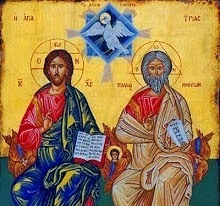
But what has all that to do with us? So much in every way. For we too have a High Priest, one far better than Aaron, and dressed in greater finery. Jesus is our “Great High Priest who has passed through the heavens” (Hebrews 4:14), gone to be “a minister in the holy places, in the true tent that the Lord set up, not man” (Hebrews 8:2). He not only wears God's name, he is God's Name. And just as Aaron the high priest placed the name of God on the people of Israel under the old covenant, so Jesus our High Priest stamps the name of God onto the people who live under the new covenant. For he is the one who's really acting whenever someone is “baptized into the Name of the Father and of the Son and of the Holy Spirit” (Matthew 28:19). As we recall especially today, the Name of God is the Name equally of Father and Son and Holy Spirit – it's a triune Name, the Name of the Holy Trinity. It is stamped onto us in baptism, as Jesus claims us for himself and for his Father by the Holy Spirit. And each and every time we gather here, through the priestly ministry of the gospel, we all have that same triune Name stamped onto us again and again in blessing – that's the point of the benediction. The Church is the New Israel, the army standing with Christ the Lamb on Mount Zion, “who had his name and his Father's name written on their foreheads” (Revelation 14:1), and who – through the perseverance of faith that works by love – are destined to bear that Holy Name for all eternity before God's face (Revelation 22:4).

And so a question hangs over our heads. We heard Ezekiel's laments and Paul's accusations of Israel as it stood either awaiting Christ or ignoring Christ. What of this New Israel that confesses Christ, baptized into the Name that the Messiah shares with the Lord GOD and with the Spirit of the LORD? We've received, or are receiving, all the gifts that God promised through Ezekiel to give Israel for the protection of his name: “I will sprinkle clean water on you, and you shall be clean from all your uncleannesses... I will give you a new heart, and a new spirit I will put within you... And I will put my Spirit within you...” (Ezekiel 36:25-27). With these greater gifts comes a deep responsibility. We carry God's name. It is lifted up on the Church's head, and on the lives of each one of us. But have we acquitted ourselves better in the new covenant than in the old? Or have our very lives lifted up God's name in vain, causing it to be profaned among the nations?

Sometimes the story has been a good one. But not always. At times, we Christians have, in fact, borne God's name to vain ends in how we've lived. There's first of all the fact of division. We've divided so far as to fall out of one communion, tearing at the unity of the one Church Jesus founded. For well over a thousand years, there have been cases where missionary efforts have been compromised by squabbles between commissioning churches over territorial jurisdiction. In Jerusalem, for as long as anyone can remember, the keys to the church built over the empty tomb of Jesus are held by a Muslim family – because the different divided factions of Christians couldn't stop fighting over it. There's a ladder that's been stuck in one spot for three centuries because they can't all agree to move it. In 2002, one monk moved his chair over an invisible line, and the fight that broke out sent eleven people to the hospital. In our divisions, we bear God's name in vain, causing it to be profaned among the nations.

And then there's the problem of violence. As far back as the dawn of the fifth century, one archbishop could tell of a time when, as he traveled into exile, a riotous band of monks showed up at the house where he was staying, bragging about beating up soldiers and threatening to torch the place with him inside it. They'd been egged on, apparently, by the local bishop, who had a bone to pick with the exiled archbishop. Elsewhere, a mob of monks thronged a governor, and one threw a rock and nearly stoned the man to death. Centuries later, in 1096, the year after the First Crusade was called, bands of Christian knights and peasants in Germany began massacring Jewish communities in spite of the efforts of Church authorities to protect them. After the Protestant revolution against Church authorities in the 1500s, believers on both sides persecuted each other to death, depending only on who had the support of political powers in each place. And as political factions and territories pledged their allegiance to different versions of Christianity, the next few centuries saw dozens of wars and hundreds of thousands of deaths. It was partly in response to these terrible wars between Christians that the so-called Age of Enlightenment swept Europe, beginning the project of reducing religious influence in society, giving birth to our secularized world of today and the rise of atheism. It's in large part because we bore God's name in vain, causing it now to be so widely profaned among the nations.

There's of course the third problem of invoking God's name to justify oppression. Think of those who, like Satan twisting Scripture in the desert, abused the Bible in the interest of an agenda of racial supremacy and even slavery. In the Civil War, both Union and Confederacy were absolutely convinced – and said so out loud – that they were fighting in God's name, whether for unity or for division, whether for liberty or for slavery. During the era of the struggle for civil rights, too many professing Christians in this country sang from their pews each Sunday morning and, by nightfall, were burning crosses in white hoods – and, I'll tell you, as the historian of our denomination, that our founding bishop himself said, “My attitude toward the Klan is sympathetic. … A number of our ministers are interested in the Klan.” Even today, on one side of the political aisle or the other, American Christians routinely have betrayed the gospel they profess by slaying it on the altar of political expediency; and the hypocrisy has driven countless people, young and old, away from the Church and from her God. In these ways, we've borne and do bear God's name in vain, causing it to be profaned in our nation.

Who could forget, either, the number of evangelists and church leaders caught up in sex scandals? It's only been fifteen years since the news came out that Ted Haggard – then the president of the National Association of Evangelicals (to which our denomination belongs) – was busy using crystal meth and buying favors from a male prostitute. (He later took initiative to reinstate himself in ministry by just starting his own church.) Other high-profile leaders caught up in sex scandals in our memory include televangelists Jim Bakker and Jimmy Swaggart, evangelist Ravi Zacharias, Catholic cardinal-archbishop Ted McCarrick, and even Billy Graham's grandson Tullian Tchividjian. Not five miles from here, at a large church we all know of, the pastor of student ministries is currently being investigated – presumed innocent until proven guilty, of course – on charges related to child pornography. As this relentless string of stories has filled the news for my entire lifetime, we have to say: plenty of prominent Christian leaders bore God's name in vain, causing it to be profaned in our nation.

But it isn't just these outrages of history or these high-profile scandals that scandalize the world. More often, it can be the everyday actions of believers whose lives betray the gospel. It's the graceless judgmentalism with which we set ourselves up as pure, good, decent, God-fearing folk, like the meanest Pharisees of old, looking down and pointing the finger and saying, “Unclean, unclean” to everything but the mirror. It's the defiant sin of the worldliness we willingly embrace as we justify surrender to the temptations that speak our language. And it's the hypocrisy of the double standards that manage to weave those two threads together into one mocking pattern of death. Talking with numerous non-believing friends over the years, I've lost track of how many have cited pastors who were afraid of questions, or parents who claimed Christian warrant for deserting their children in an hour of need, or the example of Christians who were vocally pro-life until their son impregnated someone and then were suddenly willing to pay for the abortion, or Christians who firmly judged divorce until they walked out on their families to get remarried, or Christians who turned their churches into private social clubs for their friends and gave visitors the cautious stink-eye 'til they went away. These are common threads.

Wherever any of this happens, it is we – regular Christians dropping the weight of our calling – who have so borne and worn God's name in vain that we cause it to be profaned in our family circles or our workplaces or our neighborhoods. Whenever we do not love our neighbors, we bear in vain the name of the God whose nature and name is Love. Whenever we fail to preach what God has said, we bear in vain the name of the God who is Truth; but whenever we fail to practice what we preach, we likewise bear in vain the name of the God who is the same yesterday, today, and forever. In the face of all this, it's worth knowing that it isn't a new problem. It shows up in the oldest recorded Christian sermon outside the New Testament. We don't know who preached it or where exactly, but we know the unknown preacher was speaking just a hundred years after Jesus Christ died on the cross and rose from the dead. And here's a bit of what he said:

Brethren, let's at last repent and be alert for the good, for we're filled with much foolishness and evil! … Let's not wish to please only ourselves, but – by our righteousness – also those who are outside, so that the Name isn't blasphemed because of us. For the Lord says, “Continually my name is blasphemed among all the Gentiles,” and again, “Woe to the one through whom my name is blasphemed!” How is it blasphemed? When we don't do what we say. For when the Gentiles hear from our mouths the oracles of God, they marvel at them as beautiful and great. But afterwards, when they find out that our actions aren't worthy of the words we speak, they turn to blasphemy, saying it's a myth and an error. For when they hear from us that God says, “It's no credit to you if you love those who love you, but it is a credit to you if you love your enemies and those who hate you” – when they hear this, they marvel at this extraordinary goodness. But when they see that we don't love not only those who hate us but even those who love us, they laugh at us – and the Name is blasphemed. (2 Clement 13)

It's been nearly one thousand nine hundred years since some preacher blew his congregation's minds with those words. Do we get it yet? If our lives don't match the gospel we say we believe in, then we're a stumbling stone, we're the cause of the world's cursing God, we're dragging God's sacred name through the mud, and so we wear it and bear it in vain on our lives. And, brothers and sisters, we dare not do that!

But here's the good news. By the Spirit poured into our hearts by the crucified, risen, and ascended Christ, we can lift up this holy name with our lives, we can carry it well, we can be the cause of marvelous praise among the nations – starting right here in our own backyard. The grace has been given us to really live up to this awe-inspiring privilege. From baptism to benediction, every resource you need in order to love abundantly is already at your fingertips; every glory of God's name is ready to light up your face. A bottomless well of blessings can flow through God's name engraved on your heart and soul, streaming the radiance to the world around you. Glory to the Father and to the Son and to the Holy Spirit, one God, one Trinity in Unity, one Holy Love, world without end! Amen and amen.

Sunday, May 23, 2021

Speaking His Name

It was August 1927, and the Baptist church in Wilmington was packed. Plenty of people wanted to hear the 73-year-old traveling preacher and his latest warnings. This was no ordinary preacher, in his own eyes – or, for that matter, in his own. “I am endowed with the Holy Ghost beyond millions of others!” he proclaimed. “I am the prophet of God, and I see things in a dream like a camera.” Here, people in the audience thought, was God's prophet of the twentieth century. Born into slavery in Virginia as one of his mama's eighteen children, it was the end of the war that won freedom for Andrew Jackson Jones. He'd made his way to Pittsburgh, got a job as a coachman, took up gambling. Then, he often said, in late May 1883, he was suddenly stricken blind, like Paul on the Damascus Road. His sight came back after he repented and prayed and was converted, and the following April, he started having visions of what was to come – or so he claimed.

Taking on himself the title of missionary, he began traveling through the states, foreseeing disaster on every side. He foretold Pittsburgh engulfed in flame, Boston toppled to the earth, Philadelphia blown to bits, Chicago “swept by the mighty hand of God from off the earth,” and the onset of a great famine in 1905, with “no water to drink and no bread to eat.” As the nineteenth century closed, his prophecies took on more pointed shape. He prophesied that the McKinley presidency would end with the United States in deep poverty, the government hanging by a slender thread. In 1900, William Jennings Bryan would win the presidency, leading to financial war. The famine of 1905 would last years, killing most Americans. Times would be hard until 1931.

As the twentieth century dawned, the so-called 'Prophet Jones' foresaw Atlantic City destroyed in August 1902. But that never happened, and neither had the rest. Then a world war began in Europe. Jones prophesied the United States would go to war with England and Japan, that the war would last until 1931, that few would be left alive, and that it'd take 150 years for the world to recover. But in the real world, the war ended much sooner. Jones kept pushing back the famine. Yet he kept prophesying. A second world war would begin by the end of the decade, he said, pitting the nations of the earth against the United States. “In the great conflict, the United States will be reduced to a state of subordination. France will be her only reliable ally,” while Germany would be most reluctant to fight America, having to be pressured into it by the other nations. Japanese planes would bombard the continential United States; Japanese soldiers would march in victory up Broadway. “The termination of the bloodshed will find Japan the leading power of the world,” he prophesied. The war would be over, he insisted, by 1931, when a great cataclysm would kill two-thirds of all people on earth.

Which brings us back to August '27. “I am the prophet of God,” he insisted, “and I see things in a dream like a camera. I see now a great war brewing in the house of the nations in which all nations will array themselves in battle against America to crush and humiliate her. I see three million people lying dead in New York in streets red with blood; Boston, totally destroyed; the Atlantic Ocean ripped up; every city for 500 miles around annihilated in the greatest earthquake the world has ever known.” So spoke the self-appointed prophet of doom. He said he spoke in God's name. But he was a false prophet time and again – taking God's name in vain.1

We've been journeying, these past few weeks, into the Ten Commandments. And there it is written, “You shall not take the name of the LORD your God in vain, for the LORD will not hold him guiltless who takes his name in vain” (Exodus 20:7). You might more literally translate it, “Do not lift up the name of the LORD your God in unreality,” or 'in emptiness.' Down through the centuries, as people have probed this commandment, we've seen it covering a wide range of things, and today we're going to look at five, with one more next Sunday.

First, one way of taking God's name in vain should be pretty obvious: blasphemy.2 Blasphemy is from the Greek word for 'slander,' to speak blame – specifically, to speak insults against God, against Christ, against the holy. God declared to Moses: “Whoever curses his God shall bear his sin. Whoever blasphemes the Name of the LORD shall surely be put to death. All the congregation shall stone him. The sojourner as well as the native, when he blasphemes the Name, shall be put to death” (Leviticus 24:15-16). God considered blasphemy an especially terrible way to take his name in vain. Insulting God, cursing God – that was a horrible crime.

The early church had to deal with blasphemy from plenty of corners. Outsiders, whether Jewish or pagan, could blaspheme the Christians' God. Paul himself confesses that, in ignorance, “formerly I was a blasphemer” of Jesus (1 Timothy 1:13). Our oldest picture of the crucifixion is by a pagan making fun of it: on the wall of a boarding school in ancient Rome, some student scratched graffiti with the words, “Alexamenos worships his god,” showing a young man hailing a donkey-headed man on a cross.3 Looking out at the world around them, Christians readily said that “by their tongues..., they've blasphemed the way of righteousness.”4

There were also movements in the church that came up with such kooky ideas that they were labeled as insults to God. One early heretic was famous for hating the Old Testament, describing its God as “the creator of evils, desirous of wars, inconstant in his thoughts and contradicting himself,” and saying those things was enough to get that man labeled “a blasphemer against the one real God.”5 Some movements that claimed to have a corner on the Holy Spirit were said to be “blaspheming against the Lord and the apostles and the holy church.”6 By the early fourth century, when people started coming up with the idea that Jesus was far below God, that too was seen by the church as “blasphemy” against Jesus.7

But just as bad, there was the risk in the early church that Christians themselves could be pressured into sinning with blasphemy. That was one of the motives behind some of the persecutions of early Christians: “Satan strove to have some word of blasphemy proceed from their lips.”8 Pagan authorities might demand that Christians on trial should blaspheme Jesus, revile Jesus, curse Jesus; then they'd be free to go, too hopelessly compromised to pose a threat to the status quo.9 But it didn't always take so much pressure. One early Christian recorded that he was warned that his children, who'd stopped practicing their faith, had “rejected God and blasphemed the Lord.”10

Today, things aren't so much different. The world frequently thinks it's fun or trendy to blaspheme our God, as a way of hurting us; and us, as a way of hurting him. Some of the most famous atheist authors made their name by taking the Lord's name in vain, connecting it with their various insults and parodies. In so much modern media, God is portrayed flippantly and slanderously. In today's media, Jesus is increasingly made the butt of dirtier and dirtier jokes. Blasphemy is popular in the world, and we do have to be on our guard against those forms of it, that we don't stew so long in a blasphemous culture that we become desensitized to it. But we also have to be on our guard against blaspheming God by swallowing or spreading ideas that insult him. And we especially have to be on our guard that neither we nor our children slide away from their faith, scorning the holiness to which we once were introduced. The temptations of blasphemy become greater in seasons of doubt or moments of anger, when we might be tempted to say things insulting to God, skeptical of Jesus, or demeaning to holy things that bear his touch, his presence, his name. It's easy for our pain and confusion to hear the voice of Job's wife, saying, “Curse God and die” (Job 2:9). But the psalms were written precisely to help us process all our hardest feelings without blasphemy.

A second way people have taken God's name in vain, throughout history, is by using it as a magical incantation.11 This one might seem pretty out of our experience, but we've found lots of magic papyri from the ancient world, and a lot of them routinely sprinkle various Hebrew words for 'God' alongside the names of pagan gods and an assortment of nonsense words – producing a mishmash meant to manipulate God's name like a battery, a power source we can aim where we want it by just saying the right words. From what we've found, we know that in the ancient world, some people tried to conjure the Greek god of love, to put a love spell on somebody, by binding him with the name of the God of the Bible.12 And some people tried to control demons by conjuring them with God's name.13 The Bible even tells us about Jewish exorcists in Ephesus who tried to use Jesus' name to cast out a demon; but the demon said, “Jesus I know, and Paul I recognize, but who are you?” – and then the demon cast out the exorcists (Acts 19:13-16)! They were trying to use the name of Jesus as a tool. Didn't work.

Although various forms of witchcraft are becoming trendy again in America, most of us probably are not very tempted to whip out magic spells and sprinkle God's name into them, are we? But this temptation does come in some modern forms we may not recognize – and that form is sometimes known as the 'prosperity gospel' you'll get from more than just a few preachers on TV. In the Victorian era, some people practiced what one historian calls 'mental magic.'14 A man named E. W. Kenyon infused his preaching with it, arguing that Christians could use Jesus' name not to ask but to demand that the world conform to their thoughts and wishes, and so in that way could guarantee the curing of diseases and the casting out of demons. Kenyon's influence seeped into the early phases of the Pentecostal movement, leading some to start using Jesus' name as a tool, as a talisman, as magic.15 And all these sorts of prosperity preachers are, one way or another, downstream from that. If you hear people talk about 'naming' blessings and 'claiming' blessings, that influence is there. But what this is doing – throwing around God's name like a tool to be used instead of as a prayer to the One we love – is taking God's name in vain, taking Christ's name in vain. His name is not our magic talisman. He did not tell us his name so we could control him, but so that we could know and love him. Not our will, but his be done!

A third way people take God's name in vain is through frivolous use – using it thoughtlessly in everyday talk.16 There are a lot of truly empty ways we might use words like 'God' or 'Lord' in our speech without seriously intending them to refer to him. Think of the person in surprise or exasperation who cries out, “Oh my God!” Think of the person who, faced with something shocking, shouts or mutters “Good Lord!” or “Jesus Christ!” Think of the person who, voice dripping with sarcasm, says, “Well, thank God” – or, on the other side, “God forbid...” Think of the phony “Hallelujah!”, a holy word dropped into a mundane world like a common thing. And, of course, that's to say nothing of casually invoking God and damnation upon every minor annoyance. We commonly label all these things as 'curse words.' But what sets these apart from other foul language is that they take the Lord's name in vain. Whether malicious or thoughtless, they reduce God's name and titles to ordinary words that can be thrown around and mixed with just any words. It treats God's name as if it were empty. This habit of speech takes God's name onto our lips pointlessly. If he were to answer us as though we were serious, we'd be at a loss. And Jesus warns us that “on the day of judgment, people will give account for every careless word they speak” (Matthew 12:36). If any of us have these habits of speech – habits of frivolously mentioning 'God' without meaning God – now is the time to confess, repent, and bring it to God for healing.

A fourth way people take God's name in vain is in our oaths and vows.17 In the ancient world, people in court would have to swear to God they were telling the truth, but even in the marketplace, a seller might swear to God in a customer's presence that his fruit is good, a person might swear to God that a certain thing is true, a person might promise God that they'll do a certain thing. God doesn't say we can't swear oaths or make vows – in fact, he commands that “by [the LORD's] name you shall swear” (Deuteronomy 6:13; 10:20), and promises to bless nations that learn “to swear by my name, 'As the LORD lives'” (Jeremiah 12:16). But when we do swear oaths or make vows in God's name, God takes them very seriously. “You shall not swear by my name falsely, and so profane the name of your God – I am the LORD” (Leviticus 19:12). “Love no false oath, for these things I hate” (Zechariah 8:17). “I will be a swift witness against... those who swear falsely” (Malachi 3:5).

God takes it just as seriously today. In our modern American courts, we swear to tell the truth, the whole truth, and nothing but the truth, so help us God – which is really the same as swearing to God. But even outside of court, we might thoughtlessly put emphasis on our words by saying, “Swear to God, it's true!” Or we might make promises to God – “O God, if you heal me from this, I promise I'll go to church every Sunday!” – and then, when the danger passes, we pretend it was no big deal.

During Jesus' ministry, oaths were getting out of control, because people had gone hunting for loopholes to the law instead of appreciating its spirit. That's why Jesus says, “Do not take an oath at all... Let what you say be simply 'Yes' or 'No': anything more than this comes from the Evil One” (Matthew 5:34, 37). Our Mennonite neighbors take these words as absolute, cancelling out the Old Testament command to swear to God in certain situations.18 The Church has historically taken these words not as absolute, but said that swearing to God has to meet three conditions. For one thing, the oath has to be just: it has to be something you're allowed to promise. Swearing to God that you'll worship an idol – that's off the list from the very start. For another thing, the oath has to be prudent: it has to be a proper and necessary occasion for it. Swearing to God all the time – that's a no-go. Swearing to God should be reserved for the most solemn occasions. And finally, the oath has to be truthful. Swearing to God that something's true when really it's false – that's what God will not take lightly. These are powerful things we deal with when we swear oaths or make vows or promise promises.19

But there's a fifth way people take the Lord's name in vain, and it's the last one we'll talk about today. And that way is false prophecy.20 Obviously, this was a big concern in the Bible – people going around like prophets who are either deluded or making things up, but pairing their words with God's authority, dragging his name behind their every idea and their every dream. Moses heard God say, “The prophet who presumes to speak a word in my name that I have not commanded him to speak..., that same prophet shall die” (Deuteronomy 18:20). To Jeremiah, God says, “Your prophets have seen for you false and deceptive visions” (Lamentations 2:14); “The prophets are prophesying lies in my name: I didn't send them, nor did I command them or speak to them; they're prophesying to you a lying vision, worthless divination, and the deceit of their own minds” (Jeremiah 14:14). To Ezekiel, God warns about people who “prophesy from their own hearts, 'Hear the word of the LORD!' … Woe to the foolish prophets who follow their own spirit and have seen nothing!” (Ezekiel 13:2-3).

Of course, it isn't just an Old Testament thing. A hundred years ago, we had Andrew Jones hurrying from city to city, prophesying falsely. Last year, all around the country, self-described prophets confidently said that God had shown them the outcome of the 2020 election.21 But what they said God had shown them – it wasn't true. Since Jesus poured out the Holy Spirit on Pentecost, the gift of prophecy may crop up here and there down through church history to today, but that doesn't mean we should by default trust those who lay claim to its use.

In the circles we move in, we might not run into too many self-styled prophets. But 'false prophecy,' more broadly, is using 'God-talk' as a mask for a personal agenda, for our own whims and wishes. Maybe some of you remember the story, back in '87, of the famous televangelist who caused a stir during his fundraising drive by announcing that God had revealed to him that, if he didn't raise $8,000,000 by March, he was going to die.22 Talk about manipulation! But in less flamboyant ways, any politician knows how to sprinkle some extra references to God into a speech when trying to appeal to religious voters. And many in our churches will do effectively the same. Whatever we want, we find ways of dressing it up in more spiritual language – that way, we have a better chance of convincing the pious people around us. We don't say, 'I want'; we say, 'I feel led.' In saying such things, often we end up taking God's name in vain – using his name as a tool, representing him and his authority as the source of the ideas and desires that, really, we dreamt up ourselves or got somewhere else.

Over again all of these ways of taking the Lord's name in vain, the Bible calls us to treat the Lord's name in better and higher ways. Instead of attaching it to insults and curses, we can attach it to praises and blessings to God. Instead of treating it like a talisman, a magic tool to demand what we want, we can use it in humble prayer to the God who remains sovereign and wiser than us. Instead of thoughtlessly and frivolously emptying it of its meaning, we can speak it reverently and seriously, turning our thoughts directly to God every time we lift up his name on our lips. Instead of swearing falsely by his name, we can swear in truth, good judgment, and justice, or not at all. And instead of prophesying falsely and using his name to advance our own agendas, we can simply declare the gospel – “for the testimony of Jesus is the spirit of prophecy” (Revelation 19:10).

The bad news is how many ways we can be tempted to abuse God's name – and when we look at all these ways, I don't know if any of us here can say we've never taken the Lord's name in vain. But the good news is always bigger than the bad news. And the good news is that, through Jesus, all these kinds of abuses of God's name can be forgiven. “Truly, I say to you: All sins will be forgiven the children of man, and whatever blasphemies they utter” (Mark 3:28). On the cross, Jesus bore all our blasphemies, all our false prophecies, all our manipulations and fraudulent oaths. Run to Calvary, plunge beneath the fountain that pours from his side, and be washed from them all. And in the resurrection, Jesus invites us into his own life, a life of perfect reverence for God's name. “Father, glorify your name!” he prays (John 12:28). “I have manifested your name to the people whom you gave me out of the world” (John 17:6). “I kept them in your name” (John 17:12). “Holy Father, keep them in your name” (John 17:11). Jesus' mission was to perfectly revere God's name, and to give rise to the same in us by pouring out his Spirit into our hearts. Let us be faithful in how we treat God's name on our lips. Amen.

Sunday, May 16, 2021

Crush the Idols

It was an October day in the year we'd call 539 BC, and the exiled Jews watched with excitement and rejoicing as the Persian invaders swept through the land of their captivity. Daniel in Babylon saw the writing on the wall – literally. Nabonidus – self-proclaimed “great king, strong king, king of the universe, king of Babylon..., worshipper of the great gods” – was terrified.1 He'd been terrified all year. Nabonidus – by now in his later seventies or early eighties – came back the other year, having spent a decade away at an Arabian oasis while his oldest son Belshazzar oversaw the empire. Nabonidus' efforts to shove a religious reform down Babylon's throat hadn't gone well. This past winter, though, as his former Persian allies became a threat, he'd dropped all that, returned to Babylonian tradition. And by February, he'd begun taking the idols from the surrounding towns and bringing these gods all into Babylon. He wanted to protect the idols from falling into Persian hands, of course. But in part, perhaps, he also wanted to protect himself. If he could amass the gods in Babylon, then all the powers of heaven would have 'skin in the game': they'd have a common interest with him in Babylon's defense. Manipulating them might turn the tide of the failing war. Nabonidus wanted their defense.

But it didn't work. The gods of Babylon were nothing. Their idols were nothing. For the sake of his exiled people, the one true and living God had already prophesied Babylon's downfall. Soldiers marched into Babylon on October 12 without a fight, and seventeen days later, the Persian king Cyrus arrived in person, proclaiming liberty and relief. From November through the following March, he sent the idols back where they came from, safe and sound. And soon, Cyrus proclaimed an end to the Babylonian captivity of the Jews.2

That true story illustrates how, when the Old and New Testament alike talk about idolatry, they're often being quite literal. Ancient pagans often found or crafted images representative of the gods, the powers, that they believed ruled the universe. Some believed the image was possessed by the god; others, that the image made the god present some other way. But after the inauguration ritual, they'd feed it, bow to it, parade it around. The point was to bring the god, bring the power, close enough to care for – and control.

In his words spoken in flame from the mountaintop, the LORD is incredibly insistent that Israelite religion isn't to work that way. He was quite deliberate that, when he appeared on Sinai, the general population of Israel saw no form of him, only his effects, and therefore had no idea what shape to sculpt (Deuteronomy 4:15-19). He demanded that Israel was to make no attempt to capture any powers in something they could control: “You shall not make idols for yourselves or erect an image or pillar, and you shall not set up a figured stone in your land to bow down to it, for I am the LORD your God” (Leviticus 26:1). The psalmists pointed out that debasing ourselves to lifeless things like idols only functions to suck the life right out of us: “They have mouths but don't speak, eyes but don't see, ears but don't hear, noses but don't smell, hands but don't feel, feet but don't walk, and they don't make a sound in their throat. Those who make them become like them. So do all who trust in them” (Psalm 115:5-8). The prophets went on to ridicule idolatry as insanity: “A tree from the forest is cut down and worked with an axe by the hands of a craftsman; they decorate it with silver and gold, they fasten it with hammer and nails so it can't move. Their idols are like scarecrows in a cucumber field … Don't be afraid of them, for they can't do evil, neither is it in them to do good. … The gods who didn't make the heavens and the earth shall perish from the earth and from under the heavens. … They are worthless, a work of delusion. At the time of their punishment, they shall perish” (Jeremiah 10:3-15).

But in spite of all this, Israel again and again kept falling for the doomed gods they could see. Starting from the golden calf, Israel's kings repeatedly provoked God to anger with idols (1 Kings 16:13, 26). After the divide, the northern kingdom “went after false idols and became false,” and that was their end (2 Kings 17:15-18). Yet in the south, the people still didn't learn: King Manasseh of Judah even made an idol and installed it in God's holy temple in Jerusalem (2 Chronicles 33:7). It was a besetting sin, because it was all around them.

But what about today? Ours thinks of itself as a post-Christian culture. There are no statues people praise as gods and try to feed. So what does all this matter now? Isn't ours a post-idolatry age? Alas, no. Ezekiel heard a warning from God about people who don't just bow down to the images they make with their hands, but who “have taken their idols into their hearts” (Ezekiel 14:3). Famously, the human mind has been termed a “perpetual factory of idols.”3 The LORD God says, “You shall have no other gods before me” (Exodus 20:3), but oftentimes, people will do it: they'll pick out some worldly power, some force in the world, and will focus their attention on it, placing it functionally between themselves and the true God. God says, “You shall not make for yourself a carved image or any likeness” (Exodus 20:4), but oftentimes, people will go on to represent that power in some specific and concrete way, to enshrine it in their hearts. God says, “You shall not bow down to them” (Exodus 20:5), but oftentimes, people will lessen their own God-given dignity by lowering themselves in the presence of that power. And God says, “You shall not... serve them” (Exodus 20:5), but oftentimes, people will organize the rhythms of their lives or the patterns of their thinking around their inward image of that worldly power or force. And in that way, idolatry remains a live temptation in the modern Western world no less than the ancient Near Eastern one – because we've taken our idols into our hearts.

This morning, I offer you a few examples. One power we're tempted to focus on is Mammon – money, treated as if it were a god. Now, obviously, we need purchasing power to survive in the course of day-to-day life; and we were made to work, made to act on and in the world. But this work we do was never meant to define who we are, and acquiring goods and resources and power was never supposed to be our primary pursuit. Too often, though, we do define ourselves by what we 'do for a living,' or what we've been able to accumulate. At some points in our lives, we become workaholics – we get uncomfortable if we aren't active, if we aren't producing, if we aren't accomplishing. At some points in our lives, our careers overshadow the lives and families that they're meant to support – the means to the end of sustaining a family becomes an end in itself that overshadows that family and that life. And at some points in our lives, our daydreams become captured by all the things we want to surround ourselves with. Our thoughts and feelings are discipled by the workplace. And when that happens, Mammon is the god whom we incarnate in the idol called Career, or in the idol called Household, or in any of the many little idols proposed to our eyes and ears by a relentless barrage of advertising. The trouble is, “You cannot serve God and Mammon” (Matthew 6:24). When career is an idol, when your house is an idol, when the stuff you have or wish you had is an idol, then something contrary to serving and loving God has emerged.

A second example: Another power we're tempted to focus on is Leisure or Pleasure. Now, obviously, we need to enjoy ourselves, need to rest, need to take delight in the world. And yet there's a danger here, too, just as in our work. Our hobbies and our vacations can become all-consuming pursuits, to the point that they interpose themselves between us and God, becoming in effect the idols we've introduced into his presence. Maybe we routinely go away on weekend vacations or hunting trips that tear us from the midst of God's people where God summons us. Maybe cooking a holiday dinner for family takes the place of actually celebrating the holy day for and with the holy God. Maybe sports games and music recitals, our own or our grandchildren's or simply what we see on the TV, begin to crowd out worship and service. Then we have started to bow down and serve these leisures and pleasures and enjoyments as idols; and, like seed falling among thorns, we risk being “choked by the cares and riches and pleasures of life,” and our fruit may wither and die on the bud (Luke 8:14). The Bible warns us to never be “lovers of pleasure rather than lovers of God” (2 Timothy 3:4) – but these idols appeal.

A third example: Yet another power we're tempted to focus on is Social Esteem. Now, obviously, we all – to some extent or another – want to be liked, honored, and affirmed by an audience of our peers. And in a healthy society, this is a feature, not a bug: it's designed by God to help reinforce pro-social behavior. And yet it can be blown out of proportion. The power of society to affirm or reject can become tyrannical. When treated like a god, it uses our concern for reputation to manipulate us. We strive to appease it by 'being cool' or 'going with the flow' or simply 'being normal.' We carve an image of social esteem, an image called reputation; we bow to peer pressures explicit and implicit; we serve it by organizing our lives the way everybody around us does. And yet we're warned that “whoever wishes to be a friend of the world makes himself an enemy of God” (James 4:4). We're blessed if our attachment to Jesus leads neighbors to hate us, mock us, shun us (Luke 6:22). And the reason it's blessed is that it means we've ground the idol of reputation to dust, and left its dust at Jesus' feet.

A fourth example: I'm sure you've heard the slogan somewhere in the news this past year: 'Follow the Science.' You'll note that 'Science' here always comes with a capital 'S,' even if just implicitly. Science is good as a tool for discovering and understanding the world, but in this slogan, it's Science as the image we've carved out to represent the worldly powers of Intellect and Mastery. Many segments of our society in recent years have been revealed as obsessive zealots for this idol and these gods. And in the past year, we've seen that because people have taken to praying for the idol of capital-S 'Science' to intercede for them, propitiating another taller idol. And that taller idol is Safety. Now, caution and prudence are virtues, to say nothing of the higher virtue that is love for our neighbors. But what I'm talking about goes beyond that. It can't be denied that for some people today, the prospect of perceived physical risk is so feared that any lengths, any sacrifices, can be justified to protect ourselves, to preserve ourselves. When that happens, then Safety has become an idol. We bow down to Safety when we're willing to sacrifice anything to keep ourselves safe, when we admit no limits to how far we'll go. We serve Safety when we reorganize our lives according to the one goal of self-preservation. And so, in prolonging our life and health intact, balance falls to zeal, and we insulate ourselves indefinitely. Bowing to and serving this idol stifles the Spirit's whisper into our hearts to risk everything for Jesus – knowing that a glimpse of his face is of greater value than health or even life.

But there is a fifth example. Many of our neighbors – many of us – look also to our nation to give us a sense of identity. A lot of us sing that we're proud to be Americans. We're proud of whatever values we associate with that word. Our hearts stir when we see red, white, and blue all together, or when we hear about a rocket's red glare. And, obviously, God bids us love our neighbors, and that frequently begins with our neighbors in our local civic order. And yet – and yet there's a risk here. I recently witnessed a political gathering where people who spoke consistently identified themselves with three words: “I'm a Christian, I'm a Patriot, and I support such-and-such famous politician.” And it wasn't clear which of those sources of identity really came first. As I listened to them, I couldn't help but remember a story I once read, about a pastor who got a little clumsy during Communion and spilled the cup all over a nearby American flag. That pastor later had a church member storm into his office in a rage to yell at him. Now, what do you think the church member was upset about? Was it that the pastor had mistreated the salvation-giving blood of the Almighty God by whom and in whom and for whom all things in the universe exist? Or was it mistreatment of a colored cloth symbolizing one of the many nations that arises in history and is destined to fall and fade in history? See, it should have been the first. But I think we all know that that church member's anger was stoked by the second. Because in that church – and not only there – America was the god; Jesus was the mascot.

Friends, God and country are not equals, and the cross and the flag are not equals. We may generally admit that truth, if pressed. But we need to examine ourselves to make sure we aren't just giving lip-service. See, it's very easy for us to deify our country, America as a god. And we do the same with our personal political leanings. And then the flag becomes an idol, the Constitution becomes an idol, Liberty becomes an idol, our political philosophy becomes an idol. And that has become one of the great modern American expressions of idolatry.

Maybe we let conservatism or libertarianism or liberalism or progressivism call the shots and dictate our views. Maybe we think that 'un-American' or 'undemocratic' is a word that's in and of itself enough to end all debate. Maybe we obsess over the political news and can't stop fuming about what the fox or the peacock told us about what the donkey and the elephant are up to. Maybe we find ourselves arguing so passionately that it divides us from our neighbors, or even from brothers and sisters in Christ. Maybe we let pundits disciple us in how to scorn and how to scoff. Maybe we invest civic symbols with holy power. Maybe we think that God needs America or even loves America more than other nations. Maybe we're quicker to defend the honor of our country or our politics than to defend the sanctity of the sacred. Or maybe we can't even tell the difference any more. But if any of these come true of us, then we've found something to bow down to that isn't God. We've begun to serve our politics, or patriotism, or our mental picture of our rights. We've turned from God to an idol.

These are five examples. There could be many more. These are idols – ways of trying to get the powers within our reach, ways of distracting ourselves from God. None of them bring health. The powers themselves might be neutral or even good things, healthy parts of creation, when kept in their proper place. But in singling them out, the position we put them in is unhealthy. In carving their images and likenesses within our grasp, the idols we take into our hearts are unhealthy. Sacrificing to them, lessening our dignity in their presence, bowing down to them – that's unhealthy. And organizing our patterns of thought and life around them, serving them – that's unhealthy. “As for... idolaters,” the scripture says, “their portion will be in the lake that burns with fire and sulfur, which is the second death” (Revelation 21:8). “Idolaters... will not inherit the kingdom of God,” we read (1 Corinthians 6:9-10). Why not? It's like Jonah reminds us: “Those who pay regard to vain idols forsake their hope of steadfast love” (Jonah 2:8). God hates our idols because they're unhealthy for us, and his heart breaks to see us abandon the hope of his love! His love for us is so zealous, so determined, that, while he never let idolatrous dynasties in Israel last more than three or four generations, his “steadfast love” will embrace thousands of generations of “those who love [him] and keep [his] commandments” (Exodus 20:5-6).

The good news, the great news, is found in the promise of prophets: “You will defile your carved idols overlaid with silver and your gold-plated metal images; you will scatter them as unclean things; you will say to them, 'Be gone!'” (Isaiah 30:22). “I will cut off the carved image and the metal image” (Nahum 1:14). “I will cut off the names of the idols from the land, so that they shall be remembered no more” (Zechariah 13:2). “I will destroy the idols and put an end to the images” (Ezekiel 30:13). “All her carved images shall be beaten to pieces... and all her idols I will lay waste” (Micah 1:7). “I will sprinkle clean water on you, and you shall be clean from all your uncleannesses, and from all your idols I will cleanse you,” says the Lord (Ezekiel 36:25).

The good news is that our hearts don't have to be a perpetual factory of idols. The assembly line can shut down. For God already has an image. Jesus Christ is “the Image of God” (2 Corinthians 4:4): “He is the Image of the invisible God” (Colossians 1:15). Jesus is himself God made visible, God made audible, God made tangible – God become present in our lives. We have no need to focus our gaze on worldly powers when we can fix our eyes on him as our finish line in the race of life. We have no need to carve idols when we entrust ourselves to his nail-scarred hands. We have no need to bow to idols when to bow the knee to Jesus makes us even taller than to stand on our own two feet. We have no need to serve idols when to love and serve Jesus is joy enough for a lifetime. For his indomitable life is richer than all money, more fruitful than all careers, more delightful than all hobbies, more refreshing than all vacations, more welcoming than all esteem, wiser than all science, more secure than all safety, more lordly than all politics, and more everlasting than all nations.

And while Jesus is the Image of God, each and every human person is made in the image and likeness of God (Genesis 1:26). Sometimes we image God well. Sometimes we image God poorly. But our liveliness images God all the same. “Being God's offspring, we ought not to think that the divine being is like gold or silver or stone, an image formed by the art and imagination of man” (Acts 17:29). And together, we are meant to be gathered together into the perfect Image of the Image: the Church. If Christ is like the Sun, the Church is the moon reflecting Christ's light – although for now our surface is still cratered and we do not shine so brightly, yet we come more and more to shine with a radiance not our own. The Church extends the Image of God to all the cosmos. And as the Church does that, the perceived need for idols crumbles to dust. For only we, the Church living the human calling in Christ, can adequately image God's life and dignity, so we must surrender ourselves to no dead thing, to no worldly power, to no carving meant to keep the cosmos under control.

Defile your idols. Give them up. Grind them down, crush them. Hear John: “Little children, keep yourselves from idols” (1 John 5:21). Hear Paul: “My beloved ones, flee from idolatry” (1 Corinthians 10:14). Jesus is better, now and forever! Amen.