Monday, April 12, 2010

On Glorying in the Cross

So this morning I was looking around in Thomas Aquinas' biblical commentaries to see if I'd find anything cool. Last night I was at a hymnsing, and we sang the awesome hymn "When I Survey the Wondrous Cross" by Isaac Watts, with the famous second stanza:

Forbid it, Lord, that I should boast,
Save in the death of Christ my God!
All the vain things that charm me most,
I sacrifice them to His blood.

I've always found that to be really deep and moving, and anyway the hymnal listed Galatians 6:14 ("May I never boast except in the cross of our Lord Jesus Christ, through which the world has been crucified to me, and I to the world") as a Scripture reference, so those of us at the hymnsing spent a bit of time talking about the verse. And like I said, this morning I was looking through Aquinas' commentaries and I decided to check out what he had to say about the verse. And lemme tell you, when I got to his comments on it in his fourth lecture on Galatians 6... to say I was moved wouldn't do it justice. Here, read for yourself:

Notice that where the worldly philosopher felt shame, there the Apostle found his treasure; what the former regarded as foolish became for the Apostle wisdom and glory, as Augustine says. For each person glories in that through which he is considered great. Thus a person who regards himself as great in his riches, glories in them; and so on for other things. For one who regards himself to be great in nothing but Christ glories in Christ alone. But the Apostle was such a one; hence he says, "I live now not I, but Christ lives in me" [Galatians 2:20].

Accordingly he glories in nothing but Christ and particularly in the Cross of Christ, and this because in it are found all the things about which men usually glory. For some glory in the friendship of the great, such as of kings and princes; and this friendship the Apostle found most of all in the Cross, because there an obvious sign of divine friendship is shown: "But God commends his charity towards us, because when as yet we were sinners according to the time, Christ died for us" [Romans 5:8]. For nothing shows his mercy to us as much as the death of Christ. Hence Gregory: "O inestimable love of charity! To redeem the servant, he delivered his Son."

Again, some glory in knowledge; and of this the Apostle found a more excellent one in the Cross: "For I judged not myself to know anything among you but Jesus Christ and him crucified" [1 Corinthians 2:2], for in the Cross is the perfection of all law and the whole art of living well. Again, some glory in power; and of this the Apostle found the highest form through the Cross: "The word of the cross to them, indeed, that perish is foolishness; but to them that are saved, that is, to us, it is the power of God" [1 Corinthians 1:18]. Again, some glory in newly-found freedom; and this the Apostle obtained through the Cross: "Our old man is crucified with him that the body of sin may be destroyed, to the end that we may serve sin no longer" [Romans 6:6].

Again, some glory into being accepted into some famous fellowship; but by the Cross of Christ, we are accepted into the heavenly ranks: "Making peace through the blood of his cross, both as to the things that are on earth and the things that are in heaven" [Colossians 1:20]. Again, some glory in the triumphal banners of conquest; but the Cross is the triumphal ensign of Christ's conquest over the demons: "And despoiling the principalities and powers, he has exposed them confidently in open show, triumphing over them in himself" [Colossians 2:15]; "Blessed be the wood by which justice comes" [Wisdom 14:7].

...Wow. I never really thought this deeply about just the first portion of that one verse, but it's amazing how much it can hold! Think about it: anything I could possibly justifiably boast in, I'll find more of it in the crucified and risen Christ than I ever could apart from him.

Are connections in high places the sort of thing I'd be likely to boast about? Why sell out to the world, when by being a Christian I have a direct hotline to the omnipotent God, and in fact have been given the indwelling Spirit of sonship?

How about prestigious club membership? In Christ I'm part of the communion of saints and am destined to have intimate fellowship with the cherubim and seraphim; what country club can compete with that?

What about triumphant victory? Christ beat the tar out of the powers of darkness, both on the cross and in his resurrection, and he shares that victory with us! It may be lost on me under this mortal veil of darkness, but the victory that I can personally claim through Christ makes all the conquests of Alexander the Great look like a mere pittance.

How about liberty and freedom? Some people might boast in being free and unoppressed in this human realm; that was probably far more the case in Paul's day, when slavery was yet endemic and a slave who bought his freedom really could have something to boast about. But how tiny that seems next to the idea of being set free from sin!

Or what about knowledge? Some people - that'd be me, folks - are inclined to boast in having a lot of knowledge about this or that. And those truly are good things, gifts of God... but may I never lose sight of the fact that not only do I have those treasures of earthly knowledge, but in Christ I additionally have knowledge of sacred mysteries revealed to the people of God, mysteries unattainable by my human faculties apart from grace. And that knowledge of those mysteries - mysteries like the fact that God's very nature is self-giving love, that God's character is cruciform - is so much greater than, say, verifying the existence of the Higgs boson or cataloguing the lost works from the Library of Alexandria or solving Fermat's Last Theorem or resolving the ontological status of mathematical objects. (And trust me that all of those things would be pretty cool achievements.)

Or what about wealth? There are a lot of people who could boast about that. But in Christ are all the unsearchable riches of God! How idiotic would I be to gain the wealth of all the universe and miss out on the vastly greater treasure and even lose my soul?

So if I know all this, why am I so tempted to boast in everything else? In all my natural capacities and gifts, in my connections, in my accomplishments... why am I so tempted to make such a huge fuss about myself and my works, and so little fuss about Jesus Christ and him crucified? Like Thomas Aquinas goes on to say, "a person who glories in something treasures it and desires to make it known".

O Lord, may I - like your servant Paul - learn to glory first and foremost in nothing but you and your cross, so that I may treasure your sacrifice above all else and above all else yearn with an undying passion to declare it to all people. Amen.

Saturday, March 27, 2010

Thoughts on Worship and Hell

Lately I've been reading a lot of essays by C. S. Lewis, collected in a neat volume called God in the Dock: Essays on Theology and Ethics. See, the interesting thing is that C. S. Lewis is such a popular Christian author even today, and so many of his books are total classics; but up until this past fall, when I tackled my copy of The C. S. Lewis Signature Classics, I never read his stuff. A few years earlier, I got a few pages into The Screwtape Letters and found myself bored. But this time around, I've developed my endurance quite a bit since then, and I loved it - although Lewis and I would never have seen even close to eye-to-eye on the philosophy of time. So anyway, now I'm working on God in the Dock, and as I was finishing up one of the essays, I came across a very striking passage:

Be sure there is something inside you which, unless it is altered, will put it out of God's power to prevent your being eternally miserable. While that something remains there can be no Heaven for you, just as there can be no sweet smells for a man with a cold in the nose, and no music for a man who is deaf. It's not a question of God 'sending' us to Hell. In each of us there is something growing up which will of itself be Hell unless it is nipped in the bud. (God in the Dock, pp. 154-155)

The last sentence there really struck me most of all. When we worship and obey God, we don't do it for him in the sense that we're supplying a need in him, something he's lacking that we can offer. He doesn't gain anything from our worship. God is completely self-sufficient in himself. He didn't need to create, and he doesn't gain anything new in himself by doing so. We worship God, not for his gain, but because it's the right thing to do. This is one reason why worship should never be based on feeling or emotion, although those can be (but aren't always) byproducts of worship. I worship God because it's simply right to do so, because of who he is. But on another level, in worshipping and obeying God, I do benefit myself. And no, that doesn't make it self-serving, because that benefit isn't the reason why I do any of it - or, at least, it ought not be. But I benefit myself because it's what I was made to do. I was created by God to be a God-worshipping being. Like Thomas Aquinas said, God is the proper end of man - and that's "end" in the sense of "goal", not in the sense of "conclusion". And in fulfilling my purpose, in fulfilling the function for which I was made, I gain the greatest benefit of all: complete and utter fulfillment. The way I get it now is, of course, just a shadow of what's to come; my worship of God in the present is an imperfect, shadowy reflection of the worship I'll be able to give him when all's said and done, when God makes all things new.

Some people say, "You are what you eat." But far truer than that is, "You become like what you worship." We were made in the image of God, and our destiny is to be more perfectly conformed to the true image, Christ. This is why idolatry is so dangerous. When we worship the living God, we become more greatly conformed to the ultimate source of all Life, all Love, and all Truth. And so, when we set aside all our defenses and really let God transform us as we worship him, we become increasingly like that source. But when we worship what isn't God, when we 'exchange the truth of God for a lie, and worship and serve created things rather than the Creator' (cf. Romans 1:25), what we're being conformed to is at best a shadow, not the real thing. If I devote myself to something that's at best a copy, I'll always have that thing standing as an obstacle between myself and the reality. And if I devote myself to what's imperfect, how on earth can I ever be conformed to the image of perfection; how can I ever be perfect as my Father in heaven is perfect (Matthew 5:48)? But the thing is, we all commit a sort of idolatry: suitheism, the elevation of ourselves as our own little gods. Because every act of pride, every sin, is in effect a declaration that God is not the true lawmaker and that we know better how to run our lives; and that act of declaring ourselves the ultimate authorities on ourselves is idolatrous. And when we fall into the trap of worship of self, we get stuck in an infinitely vicious recursive loop. And if we're meant to be productive, then--figuratively speaking--that sort of self-worship strikes me as the ultimate in spiritual incest, if you'll pardon the somewhat disturbing imagery.

God doesn't lay down the law arbitrarily, as though it's fun to do so or anything like that; his commandments are a glimpse at the operating manual for our nature, the operating manual that comes with being made in his image. They're a guide to true human flourishing, to entering into the realm directed and guided and enlivened and illuminated by his Spirit. So when part of that operating manual says to be oriented out from ourselves and towards him, I don't think that's because of any neediness on his part--far from it! It's because it's not only the right thing to do, but it also happens to be ultimately good for us.

We're flawed. If you don't think you are, then the only advice I can give you is to do some serious reading of Paul's ethical exhortations and then to find somewhere quiet to do a whole lot of serious introspection. The best cure for delusions of perfection is a thorough self-examination in light of what we're supposed to be. For those of us with a more realistic image of ourselves, and especially those of us who can grasp that this problem isn't just a trifling matter, I think it's easier to see Lewis' point. Apart from Christ, I have some flaw deep inside of me that's killing me; it's like a fatal poison or terminal illness. It's like chronic pain for the soul, a metaphor I can definitely relate to. And I think that Lewis may very well be right: that flaw, that pride - because some form of pride is, I think, the ultimate ground of every sin - is something that will never let us be at peace until it's dealt with. In the life we're called to live, there's no room for pride or pretensions of autonomy; we have to concede that we haven't been put at the top of the pecking order, and in fact that we didn't pick our station in the great chain of being at all. We also have to put aside all our silly notions of second-guessing God - and, let's be honest, we all do it on a pretty regular basis. Unless we do all that, we'll never be fit to live the true life, the life we're meant to live.

So like Lewis said, that flaw, left unchecked, will keep on being magnified through our self-worship; just like a proper fraction multiplied by itself keeps getting smaller and smaller, so too does our deficiency get magnified every time we worship ourselves. And left unchecked, that shrivelling up will be hell. I'm enchanted by the way Lewis portrays hell in The Great Divorce, as the uttermost in smallness, where what was once a magnificent human being has, because of its orientation inward, just collapsed in on itself and diminished. And if God is the ground of all being and the ultimate source of existence, and if our sin and imperfection is a diminishment of being - again I borrow from Thomas Aquinas - then that continual process will bring us to asymptotically approach nothingness, just as even the continual multiplication of 0.99999 will eventually get closer and closer and closer to zero.

Perhaps it was Lewis who somewhere also said that to a reprobate man (or woman), the atmosphere of heaven would be more hell than hell itself; it's not the right polarity for him (or her), and it's simply too rich and too solid, the way Lewis portrayed the heavenly life in The Great Divorce. Just as some people can't handle natural food or natural air, and so can only stomach weaker things, so none of us, because of our sinfulness, are able of ourselves to handle the life we were meant to have, and can only be acclimatized properly through grace; like Lewis' fictional tourists from hell to heaven, so if a sinner were thrust into the sort of life we'll live in God's presence someday, it would be unbearably heavy and oppressive; it would be like putting a toddler in the middle of an NFL game. If we - spiritually speaking - purposefully infantilize ourselves and spurn the grace and love of God, we'll never be hardy enough for what we were made to do and be; we will forever be wasting away. We need to put off that weakness, extirpate that cancerous seed of hell within ourselves - or, to put it more truly, to throw down our shields and cooperate as Christ treats it throughout our lives so that it won't dominate our futures in the world to come. It's just like Lewis ended that essay: "The matter is serious: let us put ourselves in His hands at once--this very day, this hour" (God in the Dock, p. 155).

Amen.

Friday, March 19, 2010

Short Thought on Love

As a Christian, I believe that God is Love. It says so in the Bible, after all (1 John 4:16). Lately I've been reading a book called Encountering the Mystery by the Ecumenical Patriarch Bartholomew I, and one of my favorite lines so far in the book has been, "Love is the ultimate content of freedom and of eternity" (125).

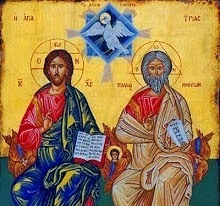
As I was contemplating that this morning, and thinking about God as Love, a thought crossed my mind: the most God-like thing anyone can ever do is love. If Love is who God is, then to be not merely godly but in fact God-like, love those around you. Love everyone. Love the broken, reach out in love to everyone who has needs. Love can restore the world, because love is a divine act, the ultimate divine act. Love is the essence of our theosis, our divinization. Athanasius once said, God "was made man that we might be made god" (On the Incarnation 54.3). To paraphrase that, Love was made man that we might be made love, that every action of ours might be so saturated with love that no single word could ever sum us up as well as "love" can. Insofar as we truly love, we're conformed ever more to the image of the Holy Trinity, that eternal community of enduring, flawless Love. "Whoever lives in love lives in God" (1 John 4:16). Every act of love is, one could perhaps say, another step along the path of becoming a god by participation in the Divine Love that timelessly antedates all created things and encompasses the whole of creation. Love is the heartbeat of heaven and earth, and love will always, without a doubt, have the final word.

O holy fire of love divine, blaze in us. Consume all that is not born of love; purify us to be living icons of Love, the expression in our day of the true Love who came to dwell among us so many centuries ago. Let us be living, breathing mirrors of divine love in a world that so desperately needs to know love, to know Love. Amen.

Monday, February 8, 2010

The Triumph of the New Life

So yesterday, I came across a quote that really struck me as cool, and it got me thinking.

Christ overcame the world by casting out the ruler of the world: "Now shall the ruler of this world be cast out" (John 12:31); "He disarmed the principalities and powers" (Colossians 2:15). This shows us that the devil is also to be overcome by us: "Will you play with him as with a bird, or will you put him on a leash for your maidens?" (Job 41:5), which understood literally means that after the passion of Christ, the little boys and young handmaids of Christ will make him [the devil] their plaything. (Super evangelium S. Joannis lectura, section 2176; trans. Fabian Larcher)

That's from Thomas Aquinas, a thirteenth-century theologian/priest/monk/professor/saint (and a whole lot more besides); it's specifically from a series of lectures he did on the Gospel of John, and I stumbled across it because I'm hoping to refer to those lectures in an upcoming paper on the doctrine of the eternal procession of the Holy Spirit in Thomas Aquinas' Trinitarian theology. But that topic is obviously not what this post is about. Instead, it's about the idea that Jesus has defeated the powers of evil, and that we share in his triumph.

We're probably all familiar with the idea that Jesus has in some sense won a huge victory. After all, like Paul said in one of the passages Thomas Aquinas already cited, "Having disarmed the powers and authorities, he made a public spectacle of them, triumphing over them by the cross" (Colossians 2:15). Thomas' specific comments on that passage in his commentary on Colossians are pretty verbose and most consist of quoting other Bible passages, but the basic idea is that Christ whupped the demonic powers somethin' fierce on Calvary that day and freed us and our forebears in the faith from the bondage of Satan, death, and sin. There's a strong tradition of viewing the atonement at least partially as Christus Victor, Christ the Victor, so that the atonement is Christ decisively beating the forces of evil by his death on the cross. (I'm not saying, like Gustaf Aulen did in his 'classic' study of the idea, that this way of seeing things exhausts the atonement; there are certainly elements of penal substitution or satisfaction involved, or something along those lines. Just to make sure I'm clear, you know.)

And we often think of ourselves as in some sense victorious. After all, Paul says, "Thanks be to God! He gives us the victory through our Lord Jesus Christ" (1 Corinthians 15:57), and who hasn't heard Eugene Bartlett's 20th-century hymn "Victory in Jesus"?

O victory in Jesus,
My Savior, forever.
He sought me and bought me
With his redeeming blood;
He loved me 'ere I knew him,
And all my love is due him;
He plunged me to victory
Beneath the cleansing flood.

But how often do we really think about the idea of sharing Christ's victory in any concrete way? I mean, yeah, we often think of it in abstract ways, like freedom from death--though even that's kinda tough to wrap your head around. That's what I love about the passage I quoted from Thomas Aquinas. I've never before thought of the idea of Christ's victory--and ours with him--as being so complete as to basically declaw, de-fang, and domesticate even the demons. Mostly, I just really love the triumphant imagery of Satan being so thoroughly defeated in the end that even little kids could basically put him on a leash and take him for a walk. In today's Christian circles, we're sometimes so worried about staving off Satan's attacks, real or perceived, that we come to fear him. And we should be wary, we should be vigilant. Don't mistake my words as an excuse to lose focus. Satan ain't no tame beast--yet. (Even though Thomas Aquinas' statement could be understood that way, I must admit.) But when I think of Satan's power being that restricted in the age to come, when I think of our victory being that total, I can't help but laugh for joy and shout praise to the Lord who fought the battle that won the victory and to the Father who passed it on to us, the faithful.

Don't let your guard down. Don't think that the forces of evil are obliterated and that we're already in paradise. There are still plenty of dangers out there for us. But don't make the opposite mistake of thinking that "Satan is alive and well on planet earth", to borrow the title of a horrible end-times book; he may be kicking, but after the death and resurrection of Jesus Christ, Satan is definitely not doing "well". And while there remain threats out there, if we're faithful, we have nothing to fear.

Human Weakness and Arts and Crafts

The other night, as I was resting in bed waiting to fall asleep, I was praying for God to pardon my habitual weakness of spirit and my tendency to stray. I know for a fact the actions I in fact enact (say that ten times fast!) frequently fall short of the divine majesty and what my Lord deserves from me. With all the good he's done for me, he's worth far more than I give in return. And then a thought occurred to me, a little scenario if you will.

Imagine a celebrated artist. His works fill an entire gallery. Think of the greatest pieces you've ever beheld--by Picasso, da Vinci, Michelangelo, van Gogh, Monet, whomever inspires you most--and this artist's work surpasses them with a beauty unparalleled. He plans, he says, to soon unveil his crowning achievement.

Imagine, too, that this artist is a kind man who has recently taken responsibility for an entire orphanage full of young children with severe disabilities. Imagine that he comes to each child, smiles, and encourages them to try their hand at arts and crafts.

And then I imagine the children coming back to him over the next few weeks, offering their pieces. Their craftsmanship is, by any strictly artistic standard, quite poor. Imagine hundreds of little arts-and-crafts 'disasters'. Disfigured popsicle-stick... shapes... dripping with glue and smeared with globs of paint. Torn pages from a coloring book, and the children ignored the lines completely. Each child proudly hands their work to this brilliant artist, saying, "I made this for you." And he smiles--no, grins, beams--as he takes each with thanks.

Imagine, then, that the time finally comes to unveil his greatest work yet. And as the curtain at last falls away, all the observers can see that this grand sculpture is composed of the children's art projects, all fitted together in a way that only a true master could achieve. And while their individual contributions, taken alone, might be meagre efforts unworthy of the prestige of the gallery, the entire ensemble crafted by the artist's care is no less than the greatest masterpiece in art history. And he turns to the children, all of whom beam with delight, and celebrates with them their joint artistic triumph.

That's the thought that crossed my mind a few nights ago as I contemplated the matter, and it made me realize something. First of all, while God deserves my best, and while my best will undoubtedly fall short of his glorious name, he's asked for my contribution, knowing fully well my limitations. The life I give over to him isn't a burden on him, some unwanted gift; it's exactly what he asked for, and God looks at the heart moreso than the results. We may not live perfect, unmarred lives, and while we do need to turn from sin and back to God on a regular basis, there's no need to live in shame because of how feeble our offering is. God asked for it; he wants it, and who am I to refuse?

The second beautiful truth that warmed my heart when I considered it is that our imperfect contributions are nevertheless the building blocks of the new world that God is building. We as craftsmen and craftswomen may not know where exactly our little baked brick will fit into the palace that God's constructing for us, but when all is said and done, I believe that we'll be able to look on the whole thing as an unparalleled beauty that confers the beauty of the whole on the parts themselves. In other words, I think that when we see history in retrospect, even our own personal life stories, we'll be able to say, "Oh that's what all that was about," and we'll rejoice in how God has chosen to forge our little pieces into a whole that's greater than just the sum of the parts. Where will my life fit? I don't know. But I do know that if I faithfully turn over my life to God, he will use it for his glory, and it'll be part of something amazing. And it will be the grounds for an eternal celebration of love.

Now to get back to the crafts project of my life.

Monday, January 18, 2010

The Acropolis and the Mission of the Church

Yeah, I know, weird title. A few months ago - early September 2009, to be exact - I finally got to study for a while in Greece. I remember seeing Athens for the first time, walking through the streets of such a famous historical city. I can't remember, though, whether it was that day or the next or the one after that, but I'm pretty sure I remember when I first saw it. The sight everybody wants to see when they go there. The Acropolis. I stopped there on the sidewalk, gazed at it for a while, took a picture or two, I think. I mean, there it was. The Acropolis. And as I stood there thinking about it, a familiar sentence floated across my mind...

"You are the light of the world. A city on a hill cannot be hidden."

It's from Matthew 5:14, of course. Jesus was giving his famous Sermon on the Mount. He was talking to his followers, his disciples, about the role he wanted them to play, as his people, in society, no matter where they went. All that stuff about salt and light, and a city on a hilltop.

Back in those times, people were pretty picky about where they wanted to build cities. Many ancient cities were situated on one or more hills, so that they'd be higher in elevation than the surrounding area. Jerusalem was built that way; that's why the Bible talks so much about "Mount Zion". And that's no doubt the image that Jesus wanted his followers to get. When he talked about a city on a hilltop, that was the one they'd be most familiar with. But other cities were built like that, too. The word "acropolis" literally means "city on the edge", more or less, but it was used to refer to the original part of the city that was especially high, the "highest city". Athens is built that way. So is Corinth, for that matter. I remember standing on the Acrocorinth, looking for miles across both land and sea. In Italy, Rome was famously built on seven hills, so it isn't just a Greek and Jewish thing.

But Greece is where I got to experience living in the shadow of a place like that. The Athenian acropolis is the one I got to know. And I learned a lot from it. Here's one of those pictures I mentioned:

For starters, the Acropolis is a major landmark. It's not just a landmark, it's basically the landmark. (Well, alright, Mt. Lycabettus has some claim to that, too.) And despite all the buildings in Athens, one of the best ways to get your bearings is to catch a glimpse of the Acropolis. Once you've done that, you can find your way around with much greater ease. At night, it can be easy to get disoriented, but fortunately the Acropolis is lit up all throughout the night. I wish I'd thought to take a good picture of it in the dark.

The point, though, is this. If you're lost, you can always look to the Acropolis to help you find your way. It shines in the darkness; no matter how dark things get, there's still light at the Acropolis. It's a beacon to weary, confused travelers. It's stood the test of time and will continue to stand. And - at least before the advent of buildings like we have today - there's no way to hide the Acropolis from view. Look in its direction, and you can't possibly miss it. There's no confusing the Acropolis for another landmark, not when you see its distinguishing marks (e.g., the Parthenon and the Erechtheum, for Athens).

What if the church - you know, we Christian folk - were really like that? What if anyone who were lost could look to us and figure out where they stand? What if we really were a reliable landmark like that? And what if we really did shine brighter and brighter, even in the darkest hour? What if we were as steadfast as the Parthenon? What if there were just no hiding us? What if we couldn't be confused with everything around us? (After all, you can't navigate by landmarks very well if you mix them up! The same seems true in spiritual things.)

We haven't always lived up to that too well. But we were meant to. It's our challenge and our mission. Can we, both as a church and as individual Christians, live like the Acropolis? Will we be the shining city set on a hill that Jesus called us to be? If we've been "rescued [...] from the dominion of darkness" to inherit "the kingdom of light" (Colossians 1:12-13) and are therefore now "children of light" (Ephesians 5:8), why don't we "shine like stars in the world" (Philippians 2:15)? Why aren't we a rock-solid landmark helping people find their way to God?

Well, sometimes we are. Sometimes we do shine, and sometimes we are a good reference point. But we're still frail, still subject to sin, still all over the map. We do ungodly things, go our own way, and just generally mess things up. Still, we also have to confess that we haven't done our best, haven't given this whole 'city-on-a-hill' thing our A-game. I certainly haven't.

But I'm resolving to do better. I'm resolving to do my part, be it meagre or be it large, to live up to Jesus' charge to his followers. That means making myself a walking, living, breathing acropolis--an unhidden, unmistakable, unambiguous landmark to help the lost find their way, even in days of dire darkness.

It won't be easy. I know I'll err, I'll waver, I'll crumble or hide from time to time. The lights will flicker, I'm sure. But if I'm not striving after this 'city-on-a-hill' life, then I'm not being as faithful a disciple as I want to be, need to be.

Will you join me?